Kaizen: The Japanese Continuous Improvement Framework, and How to Run It Daily
Kaizen is continuous improvement made in small increments by everyone as part of daily work, resting on three commitments: to small changes, to universal participation, and to observation at the workplace.
Before you start
Is this your framework?
Kaizen is about who improves things and how often, not about a technique for solving any particular problem. It answers one question: how do you get everyone making small improvements as part of ordinary work.
That makes it slow to show results and hard to start. If a specific process is failing now and somebody needs it fixed this quarter, the table below points at what will do that.
| If your real problem is… | You probably want |
|---|---|
| One process is badly broken and we need it fixed in days | Kaizen Blitz — the week-long event format, which is a different thing wearing the same name Compare Kaizen and Kaizen Blitz |
| The cause is genuinely unknown and we need evidence before changing anything | Lean Six Sigma — DMAIC, for problems that warrant months of investigation Compare Kaizen and Lean Six Sigma |
| We need to see where the work waits before improving anything | Value Stream Mapping — the flow picture that tells you where to point improvement effort |
| The workplace is disorganized and that is the real obstacle | 5S Methodology — the groundwork most kaizen programs need before suggestions get useful |
| One step limits the whole system and everything else is noise | Theory of Constraints — improving anything but the bottleneck changes nothing |
| We need to know whether we are behind, and by how much | Benchmarking — external comparison, which kaizen never provides on its own |
| Improvement only happens when someone senior pushes, and stops when they stop | Kaizen — you are in the right place |
What Is It?
Kaizen is two Japanese characters, kai and zen, usually rendered as change for the better. As a management term it carries three commitments, and dropping any one of them is what turns a kaizen program into an ordinary improvement initiative.
Small. A change small enough to try this week can be tested cheaply and reversed if it fails, so nobody needs permission or a business case. Everyone. Improvement is part of every job, not the work of a specialist function. Where the work happens. Improvement is designed at the place the work is done, which is what gemba means, rather than in a meeting room from a report.
The argument for working this way is that large changes decay. A step improvement installed by a project team erodes once the team leaves, because the conditions that made it work are not maintained by anyone. Small changes made by the people doing the job are held by those same people, so the gains accumulate instead of leaking away.
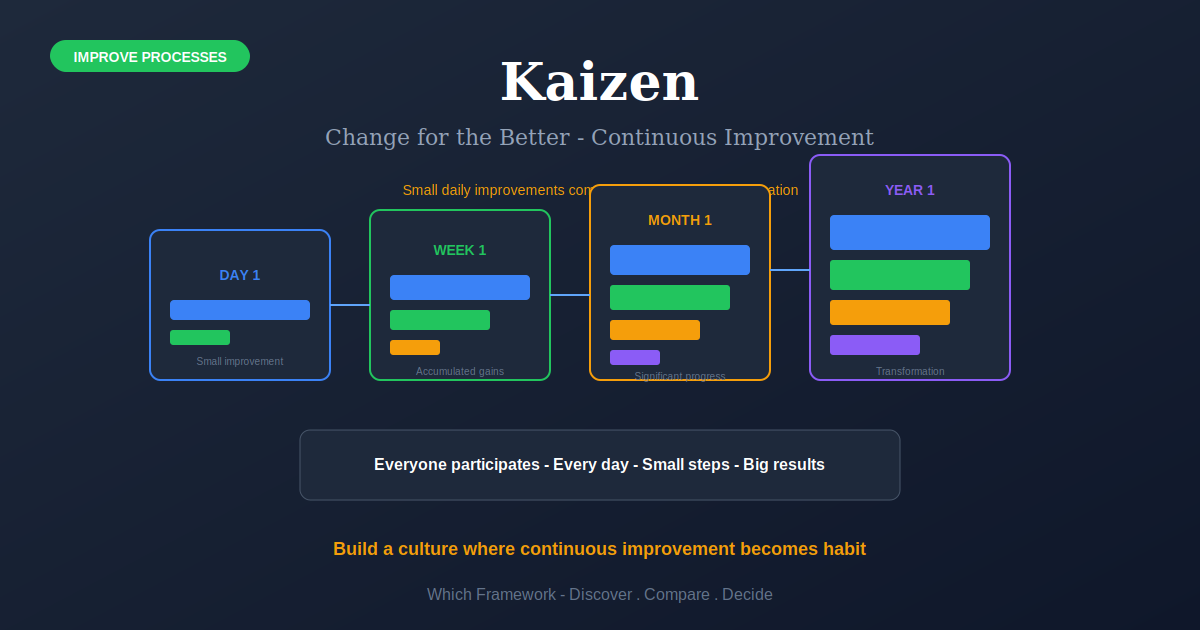
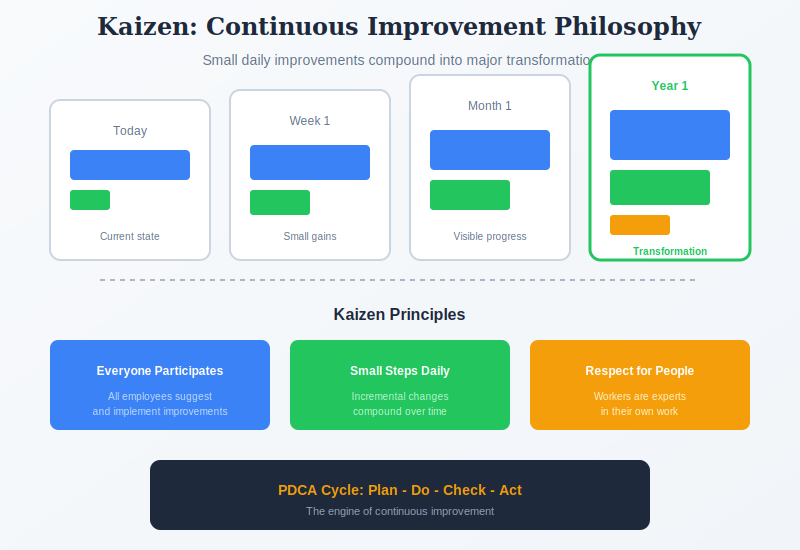
That argument is worth stating as an argument. It is the case Masaaki Imai made, it is plausible, and it is not a measured result. What is beyond dispute is the second-order effect: an organization where thousands of small changes are proposed and answered is one where problems surface early, and that is valuable whether or not the improvement curve looks the way the diagram suggests.
The cost is patience and managerial behavior. Kaizen produces very little in its first six months and asks managers to respond to a stream of small suggestions, visibly and quickly, most of which will be minor. Programs fail on that second requirement far more often than on the first.
Quick Reference
Two practices
Daily kaizen and the kaizen event
Two quite different practices go by this name, and most confusion about kaizen comes from not saying which one is meant. One is a habit; the other is a workshop.
| Daily kaizen | The kaizen event | |
|---|---|---|
| Shape | Continuous. Small changes proposed and made as part of ordinary work. | A week. A cross-functional team pulled off their jobs to fix one thing. |
| Who | Everyone, on their own process. | A selected team, usually with a facilitator, often on somebody else's process. |
| Good at | Accumulating gains that hold, because the people who made them stay. | Producing a visible result fast, and demonstrating that change is possible at all. |
| Bad at | Anything urgent. It shows almost nothing for months. | Holding the gain. The team disperses, and without daily habit the improvement erodes. |
| Fails when | Suggestions go unanswered, or counting them becomes the target. | It is the only improvement activity, so the organization improves five days a year. |
The event exists because of a travel schedule
The week-long format was not designed as a better way to improve things. Japanese consultants working with United States manufacturers in the late 1980s could not be present often enough to support daily improvement, so they compressed it into a visit. The format solves a logistics problem, and it was then adopted as though it were the method itself.
Which matters practically, because the two are complements and get treated as alternatives. Events are good at starting things and bad at holding them; daily kaizen is the reverse. An organization running events and nothing else gets a handful of improvements a year and a workforce that has learned improvement is something outsiders do.
In practice
What it asks of each level
Most of what makes a kaizen program work or fail is managerial behavior rather than method, and the requirements differ sharply by level.
| Level | What is asked | What kills it |
|---|---|---|
| The person doing the work | Notice what is awkward and propose something small. Try it where they can. | Being asked for ideas about work they do not do, which produces opinions rather than improvements. |
| The first-line manager | Answer every suggestion, visibly and quickly, including the rejections, with a reason. | Silence. One unanswered suggestion teaches more than ten implemented ones, and participation does not recover easily. |
| Middle management | Protect the time. Small improvements need slack, and a fully loaded schedule has none. | Treating improvement as what people do after the real work, which means never. |
| Senior management | Go and look at the work. Ask about the process, not only the numbers. | Setting a suggestion target. It reliably produces suggestions and reliably stops producing improvements. |
The response time is the program
If one thing is worth measuring it is not how many suggestions arrive but how long they wait for an answer. A suggestion answered within a week, even with a no, keeps the channel open. One sitting in a queue for two months closes it, and closes it for the whole team rather than for one person.
This is also why kaizen is harder in organizations with long approval chains. The method assumes the person who can say yes is close enough to the work to say it quickly. Where three signatures are needed for anything, the small change is not worth the paperwork, and people correctly stop proposing.
Core Features
- Small increments: changes cheap enough to try without a business case
- Universal participation: improvement is part of every job, not a function
- Gemba: designed where the work happens, by the people who do it
- Fast response: every suggestion answered, including the rejections
- Process as well as results: how something was done is judged, not only the outcome
- Standardization after the change: the new way is written down, or it reverts
Worked example
Two failed launches, and the number that explained both
An illustrative composite. A hospital laundry and linen service in Lisbon, Portugal, with about 130 staff across two shifts, serving four hospitals. A kaizen program had been launched twice and lapsed twice. The third attempt started by looking at why.
| What was examined | What it showed |
|---|---|
| The old suggestion box | 412 suggestions over two years. Median time to a response: 71 days. Sixty per cent never received one at all. Submissions had fallen from about 30 a month to under 4 by the end. |
| What had been suggested | Most were small and local: trolley heights, a jammed folder, where clean stock was staged. Nearly all were within a supervisor's authority to approve. None had needed the committee that had been formed to review them. |
| The target that had been set | The second attempt had asked each team for two suggestions a month. Volume rose for one quarter, then the content thinned to trivia, then it collapsed. The target had produced suggestions and stopped producing improvements. |
| What the third attempt changed | The committee was abolished. Supervisors were given authority to approve anything under about EUR 200 and one shift of labor, and were required to answer within five working days. No volume target. A whiteboard at each line showed every open suggestion and its age. |
| Where it stood after a year | Median response time four days. About 240 suggestions, roughly 160 implemented. Linen reprocessing from handling damage fell from 4.8% to 3.1%. Two of the changes came from a member of staff who had submitted nothing in the previous two years. |
Nothing about the method changed. The response time did
All three attempts used the same idea, the same word and roughly the same launch presentation. The difference was that the third one removed the committee that was creating the delay and moved the authority to the person standing next to the problem. The measured improvement in reprocessing is worth having. The change in response time is what produced it.
The abandoned volume target deserves its own note. It worked exactly as this kind of target usually does: it delivered the number for a quarter, degraded the thing the number stood for, and left people slightly cynical about the next initiative. Counting suggestions is measuring the input to a process whose output is improvements, and the two come apart as soon as anyone is held to the count.
When to Use
- Improvement only happens when someone senior pushes, and stops when they stop
- The people doing the work can see problems that never reach anyone who can act
- Work is repetitive enough that small changes compound
- Previous improvement projects delivered gains that eroded within a year
- Approval chains are short, or can be shortened
- Leadership can wait six to twelve months for visible results
When NOT to Use
- Something is failing now and needs fixing this month
- The organization is about to reorganize or shed staff, which ends participation
- Every change needs several signatures and that cannot be altered
- The work is one-off or highly variable, so improvements do not recur
- What is needed is a step change in how something is done, not refinement of it
- Managers cannot commit to answering suggestions within days
In practice
How kaizen programs go wrong
These are mostly one failure with different faces: the organization asks for participation and then does not reciprocate.
| Failure mode | What it looks like | What to do instead |
|---|---|---|
| Suggestions unanswered | A box, a queue, and no visible response. Submissions fall away within two quarters. | Answer everything within days, including the rejections, with a reason. Post the queue and its age. |
| A suggestion target | Volume rises, content thins, then the whole thing collapses and people get cynical | Measure response time instead. Never set a quota on the count. |
| A review committee | Small local changes waiting weeks for a body that meets monthly | Push approval to the supervisor with a stated money and time limit. |
| Events instead of habit | Five improvement days a year, run by outsiders, and nothing in between | Use events to start and demonstrate. Judge the program on what happens in the other 250 days. |
| No standardization | A good change made, never written down, gone when the shift changes or someone leaves | The new way becomes the documented way, same day. Otherwise it is a favor, not an improvement. |
| No slack | Fully loaded schedules, so improvement is what people do after the real work, meaning never | Protect time explicitly. An hour a week defended beats a day a quarter promised. |
| Launched during redundancies | People asked to improve productivity while jobs are being cut | Do not. State the job security position first, or wait. Nothing else will fix this. |
Sourced
Evidence, and how to cite it
The Japanese philosophy of continuous improvement has partly American roots.
Training Within Industry was a United States wartime program that certified over 1.6 million workers in more than 16,500 plants between 1940 and 1945. Its Job Methods course taught workers to break a job into steps and improve it incrementally. The program was funded into Japan during the postwar occupation, where it was received far more enthusiastically than it had been retained at home, and Masaaki Imai credits it as an origin of kaizen. The usual telling, in which continuous improvement is a purely Japanese cultural product, leaves this out.
Training Within Industry Service, US War Manpower Commission (1940–1945); Imai, M. (1986) on the program's influence.
The word reached Western management through one book.
Masaaki Imai published Kaizen: The Key to Japan's Competitive Success in 1986, drawing on his association with Toyota and on study missions he had organized to Japan. It became the standard reference and put the word into English-language management vocabulary. He had founded the Kaizen Institute in Switzerland the year before, and followed with Gemba Kaizen in 1997, which shifted the emphasis to improvement at the place work is done. Imai died in June 2023.
Imai, M. (1986) Kaizen: The Key to Japan's Competitive Success. New York: McGraw-Hill; Imai, M. (1997) Gemba Kaizen. New York: McGraw-Hill.
The improvement curve is an argument, not a measurement.
The familiar comparison — steady small gains overtaking occasional large ones that decay — is Imai's case for process-oriented over results-oriented management. It is reasoned from observation of Japanese and Western firms in a particular period, not derived from controlled comparison, and the companies held up as evidence were selected because they had succeeded. The mechanism it describes is plausible and matches what practitioners report about gains eroding. Treat the shape as a claim about why to work this way, not as a finding about how much better it is.
Imai (1986), on process-oriented versus results-oriented thinking; no controlled outcome studies of kaizen adoption are available.
The Western kaizen event is a different practice with the same name.
The week-long event format was created in the late 1980s by Japanese consultants supporting United States manufacturers, who compressed continuous support into a concentrated visit because they could not be present continuously. By Toyota's own vocabulary a concentrated step change is closer to kaikaku, radical change, than to kaizen. Both practices are useful. Using one word for both is why organizations report doing kaizen while improving five days a year.
Accounts of the origin of the kaizen event format; see also the Kaizen Blitz page.
How to cite it.
Harvard: Imai, M. (1986) Kaizen: The Key to Japan's Competitive Success. New York: McGraw-Hill.
APA: Imai, M. (1986). Kaizen: The key to Japan's competitive success. McGraw-Hill.
For workplace practice, cite Imai (1997) Gemba Kaizen. For the wartime origins, cite the Training Within Industry program and note that Imai credits it himself.
Key Strengths
- Gains tend to hold: the people who made the change are still there
- Uses knowledge that otherwise never surfaces: the operator usually knows
- Almost free: the cost is managerial attention, not budget
- Problems surface early: a workforce that reports small faults reports large ones sooner
- Compounds: small changes accumulate in a way projects do not
Key Weaknesses
- Slow: very little to show for the first six months, which is when it gets canceled
- Depends on managerial behavior: not on the method, and behavior is harder to change
- Will not produce a step change: refinement is not redesign
- Fragile: one round of redundancies ends participation for years
- Easy to fake: a suggestion count is simple to report and simple to game
Sequencing
What to run before and after
Kaizen improves whatever it is pointed at, which is a problem if nobody has decided where to point it.
Before
Sort the workplace, and find out where the work waits
Suggestions from a disorganized workplace are mostly about the disorganization. Doing the groundwork first means the improvement effort lands on things that matter rather than on tidying.
During
Use events to start, then keep the habit going between them
An event demonstrates that change is possible and produces something visible quickly, which buys the patience daily kaizen needs. It is a starter, not a substitute.
After
Watch response time, and check the gains are real
Measure how long a suggestion waits for an answer, never how many arrive. And check occasionally against the outside world, because a team can improve steadily and still be well behind.
Common questions
Kaizen: quick answers
What is kaizen?
A Japanese word meaning change for the better, used in management to describe continuous improvement made by everyone, in small increments, as part of daily work. The emphasis on all three is the point: not specialists, not large changes, and not a project with an end date.
What is the difference between kaizen and a kaizen event?
Kaizen is a daily habit; a kaizen event is a week-long workshop. The event format was invented in the late 1980s by Japanese consultants who could not fly to the United States often enough to support the daily kind, so they compressed it. Both are useful. Only one of them is what the word originally described, and running events alone gives you improvement projects rather than a culture.
Is kaizen Japanese or American?
Both, in sequence. The word and the mature practice are Japanese. The seed was a United States wartime program, Training Within Industry, taken to Japan during the postwar occupation. Its Job Methods course taught workers to break down a job and improve it in small steps, and Masaaki Imai credits it as an origin of kaizen. Japan kept and developed what the United States largely abandoned after 1945.
What are the core principles of kaizen?
Improvement is everyone's job, not a specialist function. Small changes are preferred to large ones because they can be tested and reversed cheaply. Improvement happens where the work happens, which is what gemba means. Process is judged as well as results. And problems are treated as information rather than as failures, which is the part that requires managers to change behavior.
What is gemba?
The actual place where work is done and value is added. The instruction to go to gemba means observing the work in person rather than reasoning about it from a report or a meeting room. It matters because the people doing a job usually know what is wrong with it, and that information rarely survives the trip up a hierarchy.
Why do kaizen programs fail?
Almost always for the same reason: suggestions are collected and nothing visible happens to them. A suggestion answered late, or not at all, teaches everyone that the system is decorative, and participation does not recover easily once that lesson lands. The second most common cause is tying suggestion counts to targets, which produces suggestions rather than improvements.
What is the difference between kaizen and kaikaku?
Kaizen is small incremental change. Kaikaku is radical change, a deliberate break with how something is currently done. The distinction matters because much of what Western organizations call a kaizen event is closer to kaikaku, and calling a step change by the name of incremental improvement muddles what people expect from either.
How do you cite kaizen sources?
For the term and its Western introduction, cite Imai, M. (1986) Kaizen: The Key to Japan's Competitive Success, McGraw-Hill. For the practice at the workplace, cite Imai, M. (1997) Gemba Kaizen. For the wartime origins, cite the Training Within Industry program and note that Imai himself credits it.
Deep Resources
Frameworks related to Kaizen
- Kaizen BlitzThe week-long event format, invented in 1988 and often confused with the daily practice…
- 5S MethodologyThe workplace groundwork most kaizen programs need before suggestions get useful…
- Value Stream MappingWhere the work waits, so improvement effort lands somewhere that matters…