FreeNo sign-upYour notes stay on your computer
Delegation Tool
Hand off work as your team grows, and make it stick: find the skills only you have, decide what goes to whom and with how much authority, give every decision one owner, check that problems reach the new owners early, set outcomes, and plan who steps up next. Six stages, ending with your delegation plan and a succession plan in one full report.
The tour runs all six stages on an example software agency. Nothing in it touches your own work. The six stages take two weeks on the fast track, or a full quarter done thoroughly; stage 4 waits 4 to 6 weeks after the handovers.
Six stages, in order
Each stage asks one question and hands its answer to the next. You can stop after any stage: save your progress file, and pick up later on any computer. The delegation playbook explains the method behind each one.
-
Stage 1 of 6 · Skills Matrix
Who can do what today?
1 to 2 days
- You bring
- Everyone you could hand work to, and the skills the work needs, written as the work.
- You get
- Each person rated on each skill, the skills only you have, and who is closest on each.
How a skills matrix worksUse the skills matrix tool on its own
-
Stage 2 of 6 · Delegation Matrix
What should you hand off, and to whom?
An afternoon
- You bring
- Everything you do in a normal fortnight, with rough hours.
- You get
- Each task sorted by importance and skill, who takes it, how much authority goes with it, and the hours it frees.
How the delegation matrix worksUse the delegation matrix tool on its own
-
Stage 3 of 6 · RACI Matrix
Who decides what?
Half a day
- You bring
- The decisions behind the work you hand over, and the ones that wait for you.
- You get
- A chart with one accountable owner for every decision, and the rows where you kept the A.
-
Stage 4 of 6 · Psychological Safety
Will people raise problems early?
4 to 6 weeks after the handovers
- You bring
- What you have seen since the handovers, and an optional anonymous team survey.
- You get
- Three warning signs read, a habit for each one you see, and whether it is time to set goals.
How psychological safety worksUse the psychological safety check on its own
-
Stage 5 of 6 · OKRs
What should people deliver?
1 to 2 weeks, in one planning cycle
- You bring
- A conversation with each new owner about what their work should change.
- You get
- One objective per owner with two to four key results, each tested: a result, not a task.
-
Stage 6 of 6 · Succession Planning
Who steps up next?
2 to 3 days, then yearly
- You bring
- An hour on each key role: who could step in now, and who in a year or two.
- You get
- Who is in line for each key role, the first step to get them ready, and whom to hire where nobody is.
How succession planning worksUse the succession planning tool on its own
What you finish with
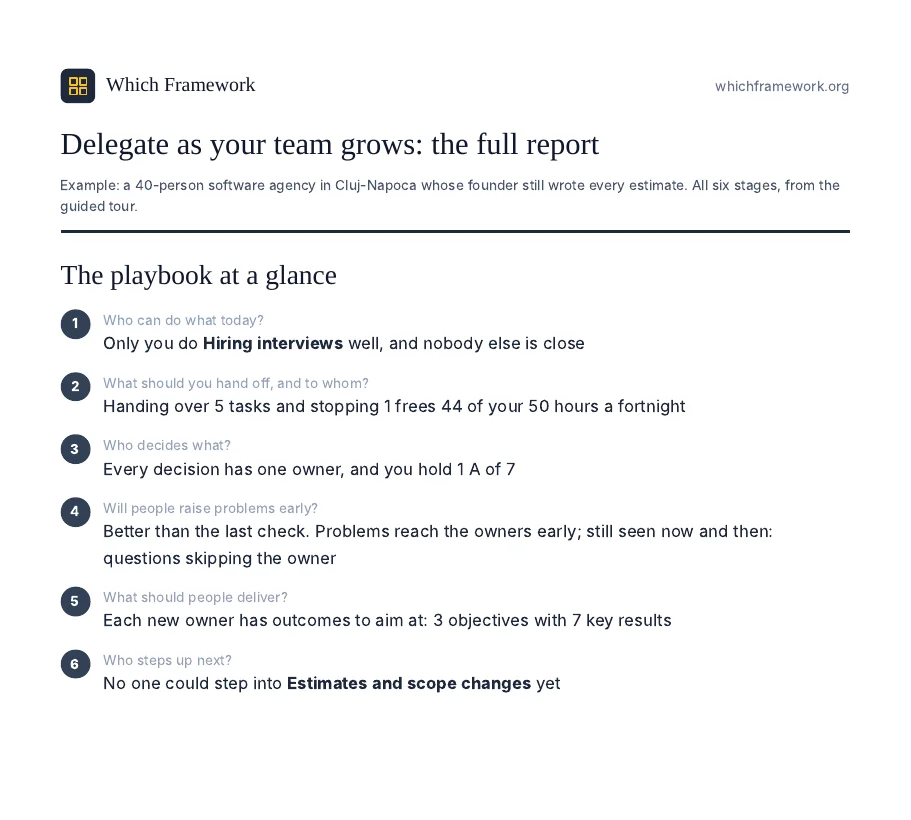
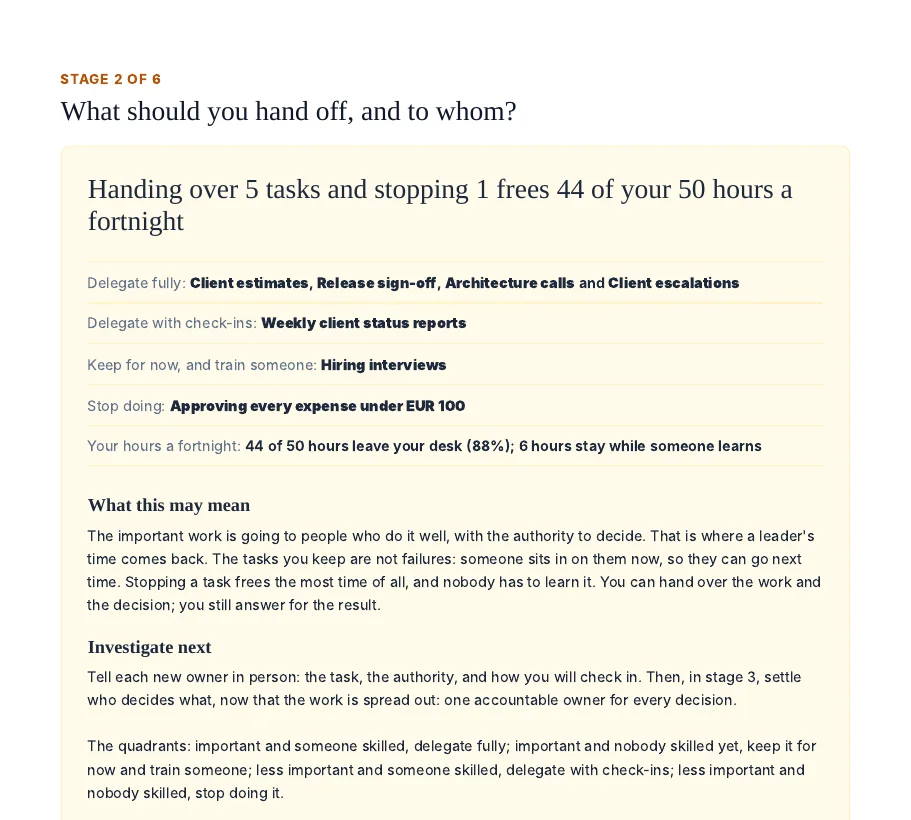
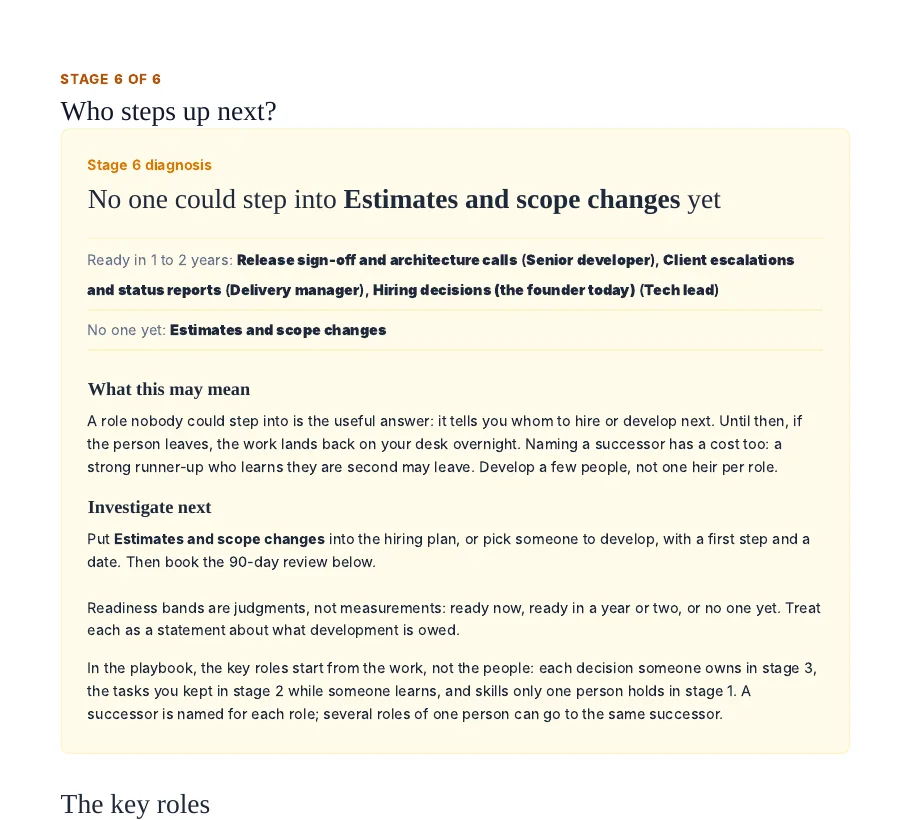
From the guided tour: a 40-person software agency in Cluj-Napoca whose founder still wrote every estimate.
Download the example report (PDF, 8 pages)A PDF report of the whole playbook. One headline for each stage, as in the example, then each stage's diagnosis: what it found, what that means, and what to do next. It ends with the succession plan and a 90-day review with three checks.
A progress file you keep. An Excel workbook with a sheet for every stage, updated each time you save. It holds each safety check and the OKR scores, and it is how you come back: choose it on this page or on any stage, and the playbook reopens where you left off.
Checks along the way. A skill only you have is taught before it is handed over; every handover says how much authority goes with it; a decision with two owners stops the playbook; and outcome goals wait until problems reach the new owners early.
Questions
Is it free?
Yes. There is no sign-up. The PDF report asks for an email address; everything else works without one.
Where do my notes go?
Names, tasks, decisions and notes stay in your browser and in the progress file you download. To write each stage's diagnosis, the page sends our server only ratings, counts and the places of people and tasks in your lists, never the names or the words.
Do I have to do all six stages?
No. Each stage also works on its own, from the tools page. If you only need to settle who decides what on one project, start at stage 3.
Can several people work on it?
Yes, by passing the progress file. Save it after a stage, send it to a colleague, and they choose it on this page to carry on from there.
How is this different from the playbook article?
The article explains the method and follows one company through it. The tool runs the same six stages on your own team, and writes the diagnosis at each one.