FreeNo sign-upYour notes stay on your computer
Change Management Tool
Plan an organizational change and bring people through it: map who it affects, plan it for the whole organization, find where each group is stuck, answer the real reasons behind the pushback, and plan the dip after go-live. Five stages, ending with a transition plan and a full report.
The tour runs all five stages on an example insurer. Nothing in it touches your own work. Stages 1 and 2 take one to three weeks before the change is announced; stages 3 to 5 then run side by side for months, with a check each month.
Five stages, in order
Each stage asks one question and hands its answer to the next. You can stop after any stage: save your progress file, and pick up later on any computer. The organizational change playbook explains the method behind each one.
-
Stage 1 of 5 · Stakeholder Analysis
Who does the change affect?
2 to 3 days
- You bring
- An hour with the people leading the change, to list every group it touches, inside and outside.
- You get
- Each group placed by power and interest, with its stance today, a first move, and who to meet before announcing anything.
How stakeholder analysis worksUse the stakeholder analysis tool on its own
-
Stage 2 of 5 · Kotter's 8 Steps
What is the plan for the whole organization?
1 to 2 weeks to plan; the steps run for months
- You bring
- The figures behind the change, the leaders' agreement, and names for a guiding coalition.
- You get
- A case for why now, a coalition people trust, and one action for each of the eight steps on one timeline.
-
Stage 3 of 5 · ADKAR
Where is each group stuck?
A first check 2 to 3 weeks after the announcement, then monthly
- You bring
- Five questions to each group whose work changes, in a short survey or team meetings.
- You get
- Each group's barrier point, one action aimed at it, and the trend from one month to the next.
-
Stage 4 of 5 · Resistance Management
Who is pushing back, and why?
From the announcement onward, alongside stage 3
- You bring
- What people said, in their own words, from conversations with the groups pushing back.
- You get
- The real reason behind each objection, a response that fits it, and the plan changed where an objection was right.
How resistance management worksUse the resistance tool on its own
-
Stage 5 of 5 · Bridges' Transition
How do people let go of the old way?
From the announcement, for 3 to 12 months
- You bring
- A go-live date, the output you expect to dip, and one measure of people working the new way.
- You get
- Support for each phase, the dip planned and announced in advance, and reviews at 3, 6 and 12 months.
How Bridges' model worksUse the transition planner on its own
What you finish with
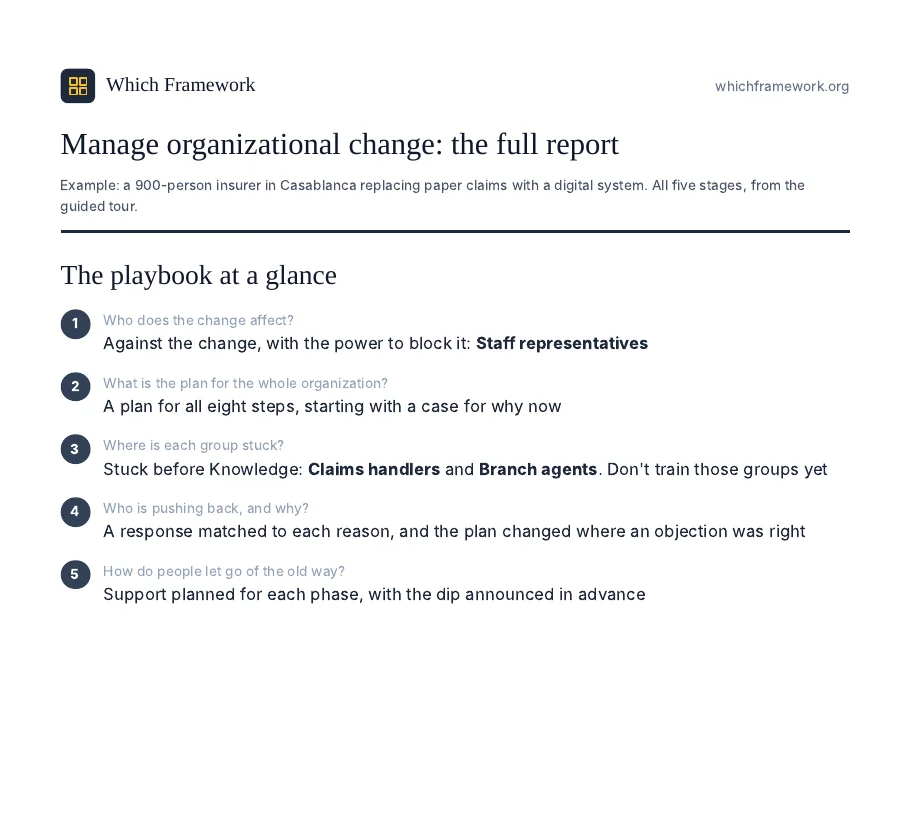
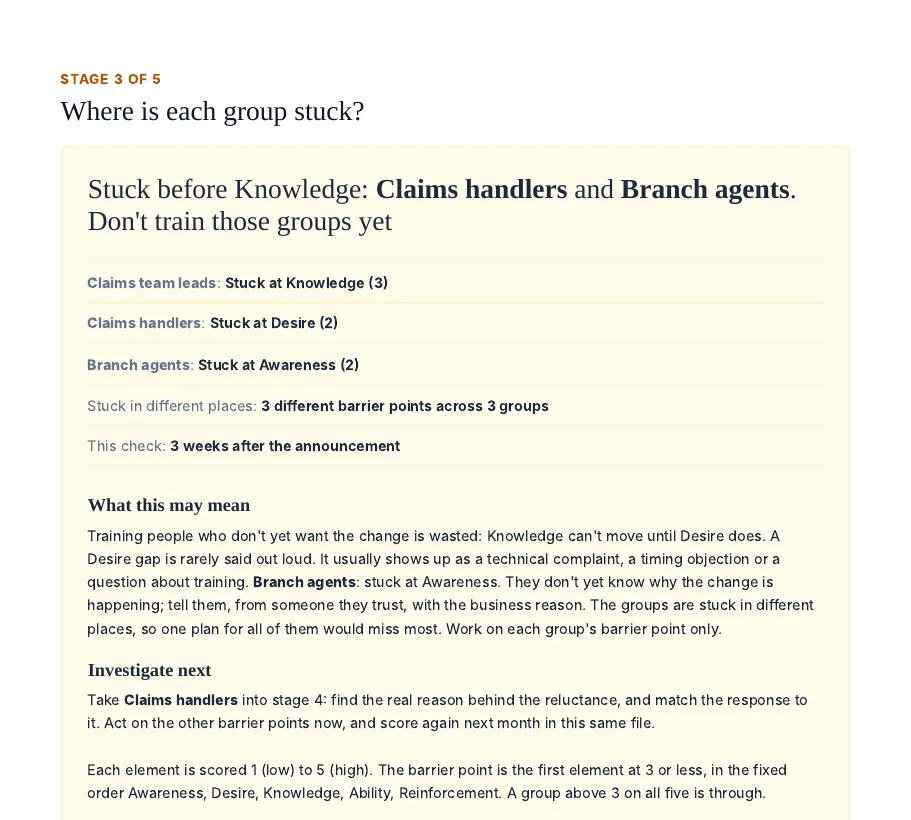
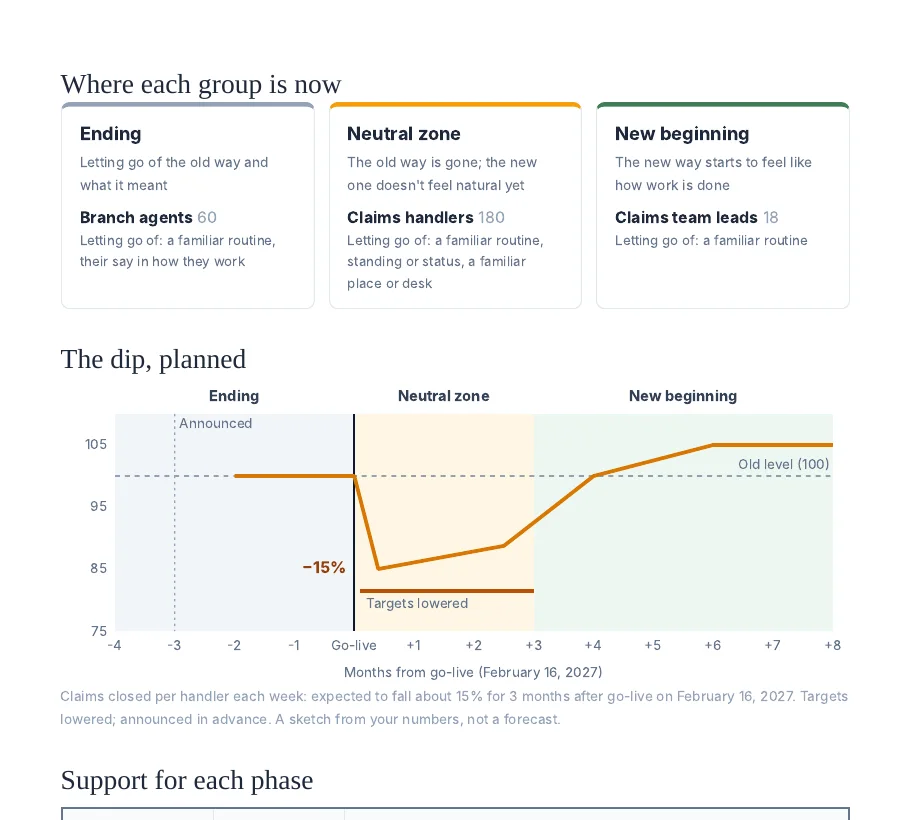
From the guided tour: a 900-person insurer in Casablanca replacing paper claims with a digital system.
Download the example report (PDF, 8 pages)A PDF report of the whole playbook. One headline for each stage, as in the example, then each stage's diagnosis: what it found, what that means, and what to do next. It ends with the transition plan and how you'll know the change stuck.
A progress file you keep. An Excel workbook with a sheet for every stage, updated each time you save. It holds a year of monthly ADKAR checks, and it is how you come back: choose it on this page or on any stage, and the playbook reopens where you left off.
Checks along the way. A powerful opponent is met before anything is announced; the plan stops without a case for why now; a group stuck before Knowledge isn't trained yet; and an objection that holds up changes the plan.
Questions
Is it free?
Yes. There is no sign-up. The PDF report asks for an email address; everything else works without one.
Where do my notes go?
Group names, quotes and plans stay in your browser and in the progress file you download. To write each stage's diagnosis, the page sends our server only scores, counts and the places of groups in your lists, never the names or the words.
Do I have to do all five stages?
No. Each stage also works on its own, from the tools page. If the change is already planned and people just aren't adopting it, start at stage 3.
Can several people work on it?
Yes, by passing the progress file. Save it after a stage, send it to a colleague, and they choose it on this page to carry on from there.
How is this different from the playbook article?
The article explains the method and follows one company through it. The tool runs the same five stages on your own change, and writes the diagnosis at each one.