FreeNo sign-upYour notes stay on your computer
Strategy Execution Tool
Turn a strategy into work that happens: write the few objectives it depends on and link them, measure each one, check the organization can deliver them, agree each yearly target with the person who owns it, and give every team a quarter to steer by. Five stages, ending with a review rhythm and a full report.
The tour runs all five stages on an example dairy company. Nothing in it touches your own work. Stages 1 to 4 make up the yearly planning cycle: one offsite on the fast track, or six to eight weeks done thoroughly. Stage 5 then repeats every quarter.
Five stages, in order
Each stage asks one question and hands its answer to the next. You can stop after any stage: save your progress file, and pick up later on any computer. The strategy execution playbook explains the method behind each one.
-
Stage 1 of 5 · Strategy Map
What has to go right for the strategy to work?
1 to 2 weeks
- You bring
- The chosen strategy in one line, and the leadership team for a morning.
- You get
- A dozen or fewer objectives in four layers, each linked to what it drives, and the ones that drive nothing cut.
How a strategy map worksUse the strategy map builder on its own
-
Stage 2 of 5 · Balanced Scorecard
How will you measure progress on each objective?
1 to 2 weeks
- You bring
- The data you already collect, and a name for each objective's owner.
- You get
- One or two measures per objective, where each stands today, this year's target, the initiative and one owner.
How the balanced scorecard worksUse the balanced scorecard tool on its own
-
Stage 3 of 5 · McKinsey 7S
Is the organization set up to deliver the strategy?
1 week
- You bring
- Honest answers about structure, pay and skills, ideally from below the leadership team too.
- You get
- The seven elements rated against the strategy, and what to change, by when and who owns it.
How the McKinsey 7S framework worksUse the McKinsey 7S assessment on its own
-
Stage 4 of 5 · Hoshin Kanri
Who commits to what this year?
3 to 4 weeks, once a year
- You bring
- Time with each department head to propose, hear the reply and agree.
- You get
- Every yearly target proposed, replied to and agreed, the ones waiting on a change, and projects that serve nothing.
How Hoshin Kanri worksUse the Hoshin Kanri planner on its own
-
Stage 5 of 5 · OKRs
What does each team do this quarter?
A week each quarter
- You bring
- Everyone who committed to a yearly target, for an hour each.
- You get
- One objective per person with two to four key results, each traced to a yearly target, and the review rhythm with dates.
What you finish with
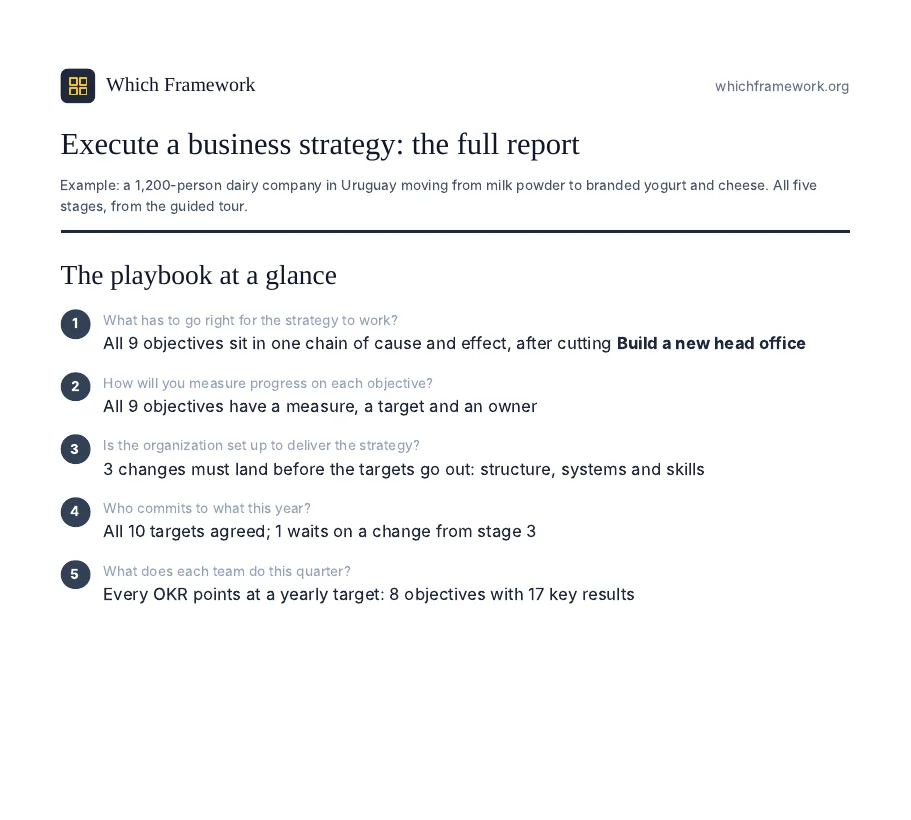
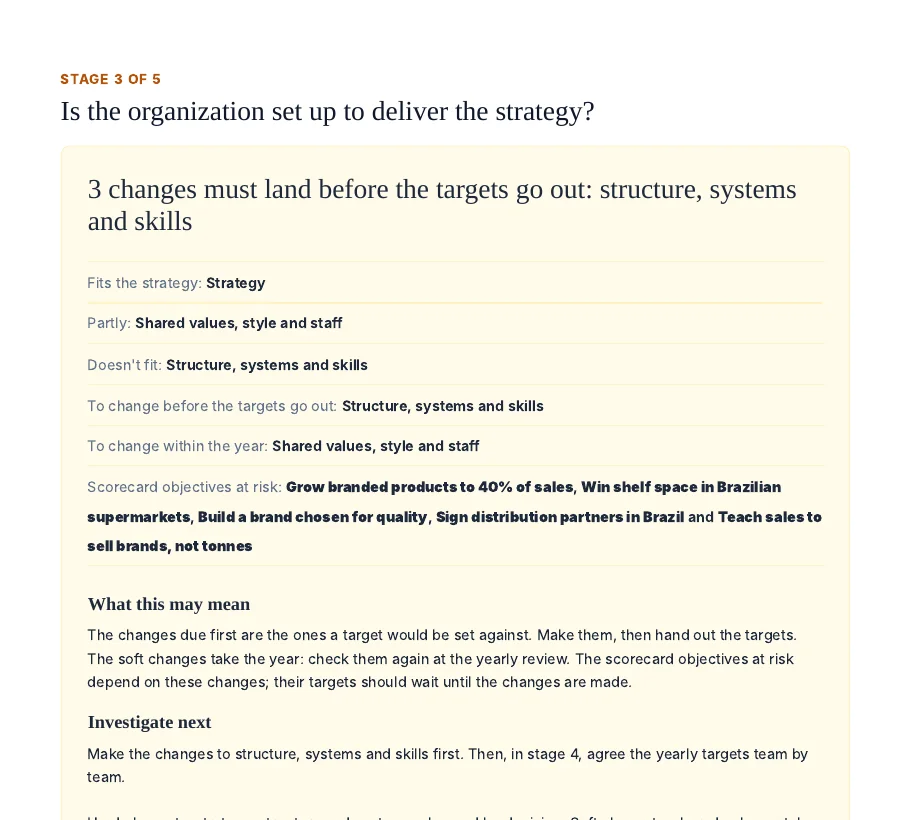
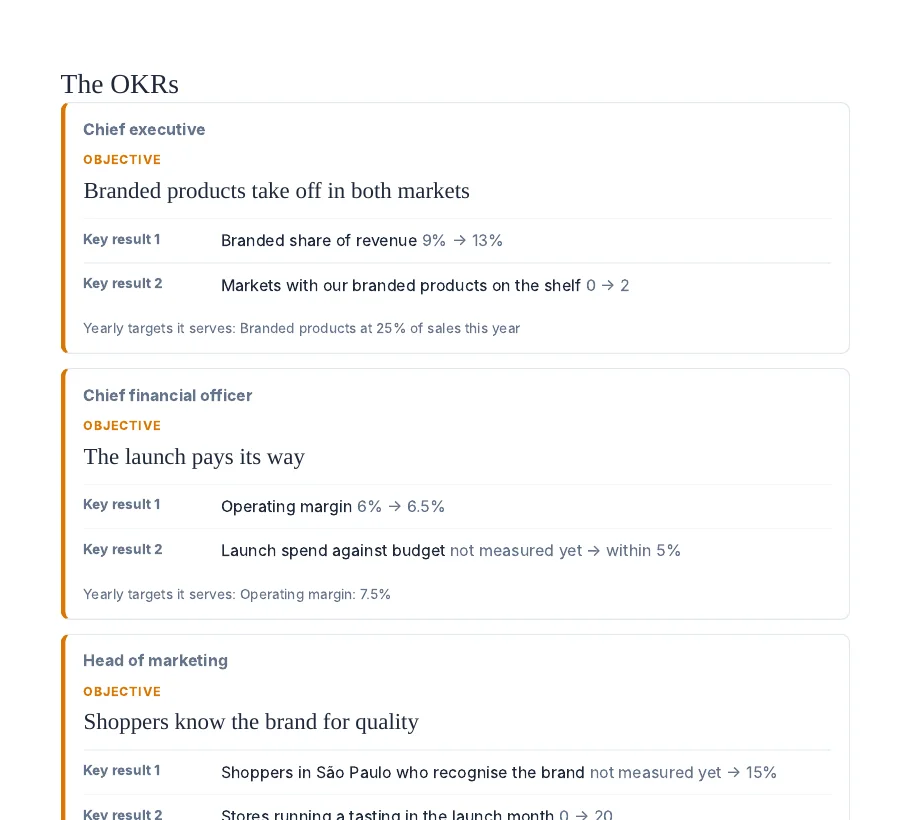
From the guided tour: a 1,200-person dairy company in Uruguay moving from milk powder to branded yogurt and cheese.
Download the example report (PDF, 9 pages)A PDF report of the whole playbook. One headline for each stage, as in the example, then each stage's diagnosis: what it found, what that means, and what to do next. It ends with the quarter's OKRs and the review rhythm, with dates.
A progress file you keep. An Excel workbook with a sheet for every stage, updated each time you save. It is how you come back each quarter: choose it on this page or on any stage, and the playbook reopens where you left off.
Checks along the way. An objective that drives nothing is flagged for cutting; a scorecard of money alone is stopped; a hard element of the organization left unfixed stops the targets; a target not yet agreed is never signed; and a key result that reads like a task is flagged.
Questions
Is it free?
Yes. There is no sign-up. The PDF report asks for an email address; everything else works without one.
Where do my notes go?
Objectives, measures, names and notes stay in your browser and in the progress file you download. To write each stage's diagnosis, the page sends our server only counts, ratings and the places of items in your lists, never the names or the words.
Do I have to do all five stages?
No. Each stage also works on its own, from the tools page. If the leadership team has already agreed its objectives, start at stage 2.
Can several people work on it?
Yes, by passing the progress file. Save it after a stage, send it to a colleague, and they choose it on this page to carry on from there.
How is this different from the playbook article?
The article explains the method and follows one company through it. The tool runs the same five stages on your own strategy, and writes the diagnosis at each one.