FreeNo sign-upYour figures stay on your computer
Market Share Growth Tool
Before cutting a price to win share back, find out where it went and why. Measure share by product line, choose the one line worth pushing and the one that pays for it, test what rivals can't copy, pick one basis of competition, then decide what to drop, cut, raise and add. Five stages, ending with early signs to track and a full report.
The tour runs all five stages on an example paint maker losing share in exterior paint. Nothing in it touches your own work. Six to eight weeks in all. Most of it is stage 1 (finding market sizes and asking buyers why they chose) and stage 5 (having buyers score you and your rivals). Stages 2 to 4 take a day or two each.
Five stages, in order
Each stage asks one question and hands its answer to the next. You can stop after any stage: save your progress file, and pick up later on any computer. The market share playbook explains the method behind each one.
-
Stage 1 of 5 · Market share
Where are you losing share, and to whom?
2 to 3 weeks
- You bring
- Your sales for each product line over the last four years, the size of each market, and the answers of 10 to 20 buyers asked why they chose the brand they did.
- You get
- Your share of each line's market by year, the line losing the most and the rival taking it, and the factors buyers weigh, counted.
-
Stage 2 of 5 · BCG Growth-Share Matrix
Which product lines are worth fighting for?
1 to 2 days
- You bring
- How fast each line's market grows, and the share of the largest rival in it.
- You get
- Each line on the matrix, one line to push for share, the line that funds it, and whether more share actually pays in your business.
How the BCG matrix worksUse the BCG Growth-Share Matrix Tool on its own
-
Stage 3 of 5 · VRIO
What do you have that rivals can't copy?
1 to 2 days
- You bring
- What you have behind the chosen line: resources, skills and relationships, and an honest view of what rivals have.
- You get
- Each resource tested with four questions: lasting advantages, ones you aren't using yet, and ones rivals could soon match.
-
Stage 4 of 5 · Porter's Generic Strategies
On what basis can you win?
1 to 3 days
- You bring
- How each main rival competes, and who has the lowest cost per unit.
- You get
- One position, lower cost or something different, across the market or for one segment, and what it rests on. A price cut without the lowest costs is stopped.
How Porter's generic strategies worksUse the Porter's Generic Strategies Tool on its own
-
Stage 5 of 5 · Blue Ocean Strategy
What do you change in your offer?
2 to 4 weeks
- You bring
- How buyers score you and two or three rivals, 1 to 5, on the factors from stage 1.
- You get
- Your strategy canvas, what to eliminate, reduce, raise and create, which raises rivals could copy fast, and early signs to track every month.
How the blue ocean strategy canvas worksUse the Blue Ocean Strategy Tool on its own
What you finish with
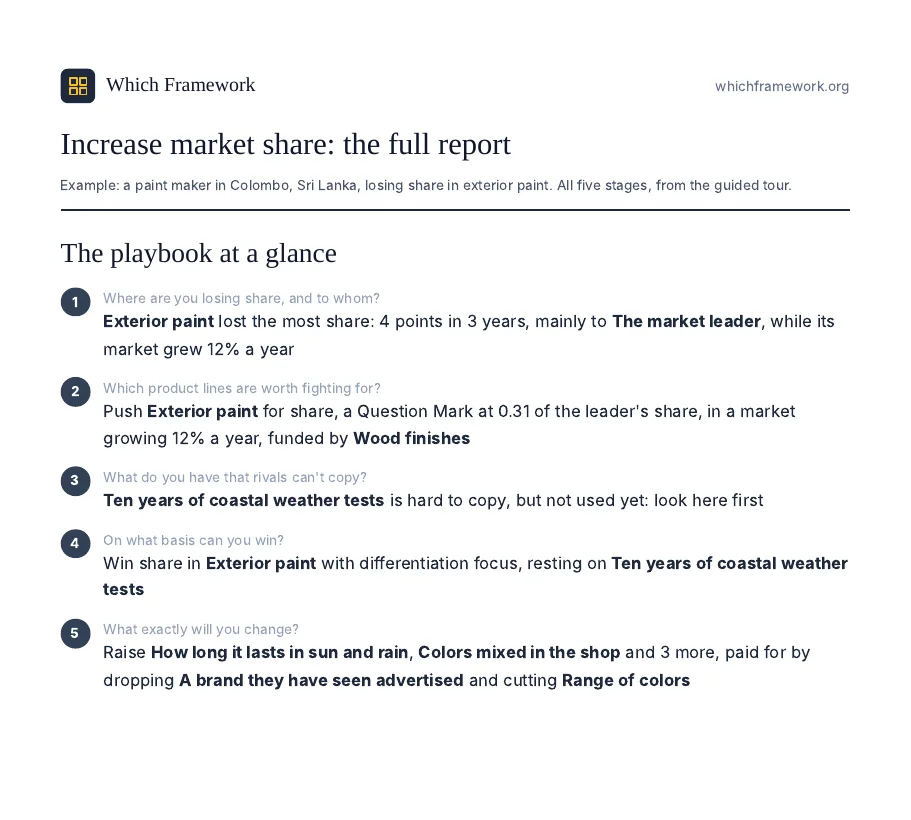
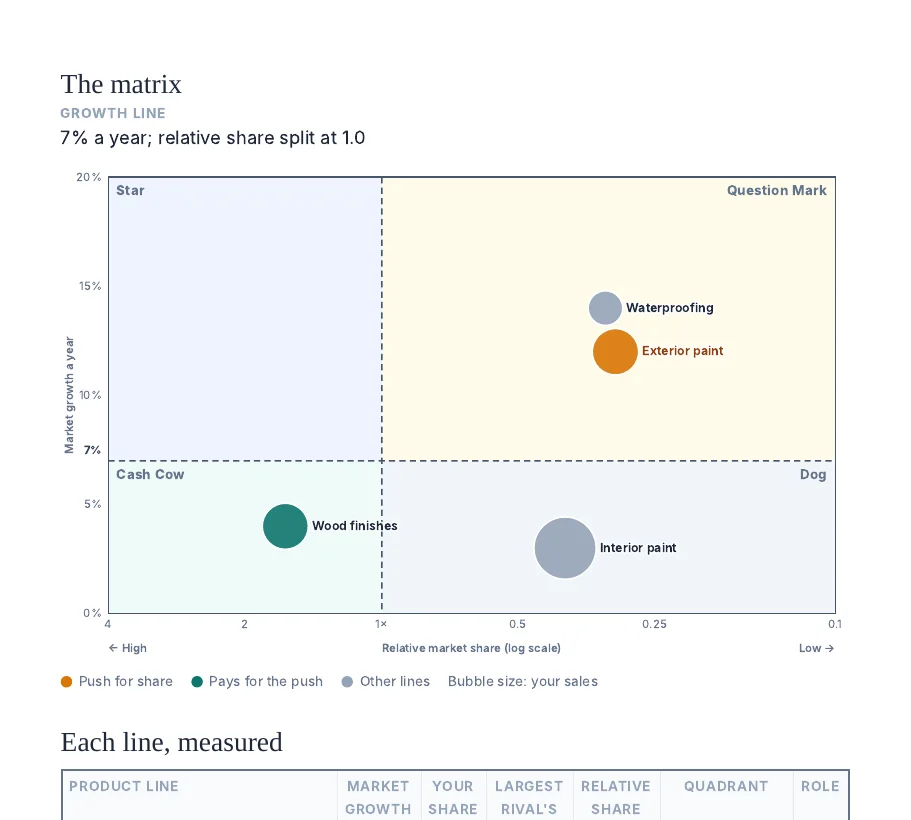
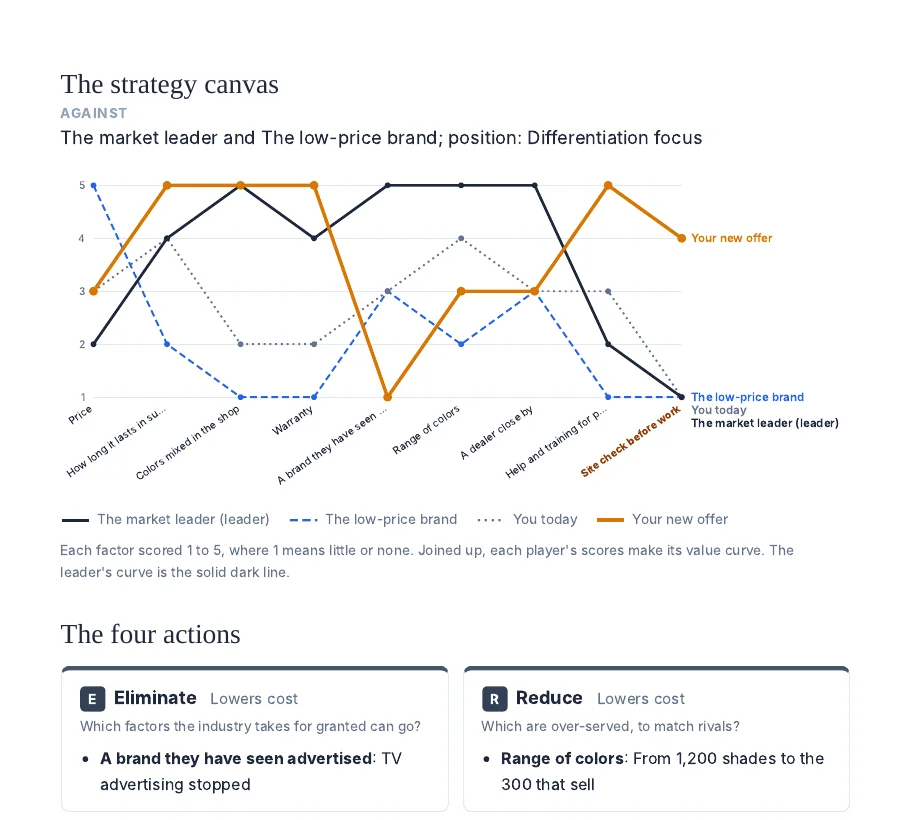
From the guided tour: a paint maker in Colombo, Sri Lanka, losing share in exterior paint.
Download the example report (PDF, 15 pages)A PDF report of the whole playbook. One headline for each stage, as in the example, then each stage's full results: the charts, the tables and the diagnosis, with what it means and what to do next. It ends with the changes to your offer and the early signs to track.
A progress file you keep. An Excel workbook with a sheet for every stage, updated each time you save. Choose it on this page or on any stage, and the playbook reopens where you left off.
Checks along the way. Falling sales in a shrinking market are sent to the market expansion playbook, not a fight for share; pushing two lines at once, or a line nothing pays for, is flagged; a price cut without the lowest costs is stopped; and an offer that only adds, with nothing cut to pay for it, is sent back.
Questions
Is it free?
Yes. There is no sign-up. The PDF report asks for an email address; everything else works without one.
Where do my figures go?
Product lines, rivals, resources and factors stay in your browser and in the progress file you download. To write each stage's diagnosis, the page sends our server only figures and the places of items in your lists, never the names or the words.
Do I have to do all five stages?
No. Each stage also works on its own, from the tools page. With only one product line, stage 1 takes you straight to stage 3.
Can several people work on it?
Yes, by passing the progress file. Save it after a stage, send it to a colleague, and they choose it on this page to carry on from there.
How is this different from the playbook article?
The article explains the method and follows one company through it. The tool runs the same five stages on your own figures, and writes the diagnosis at each one.