FreeNo sign-upYour figures stay on your computer
Cost Reduction Tool
Narrow down before you cut: split last year's overruns into price and usage, compare your costs with comparable businesses, find which products and customers lose money once overhead is traced to them, then rebuild next year's budget from zero, ranked. Four stages, ending with a budget to check every month and a full report.
The tour runs all four stages on an example manufacturer whose margin fell from 7% to 2%. Nothing in it touches your own work. Two to three weeks on the fast track. Done thoroughly, stages 1 to 3 take six to ten weeks, and stages 2 and 3 can overlap. Stage 4 fits the yearly budget cycle, and stage 1 then runs every month.
Four stages, in order
Each stage asks one question and hands its answer to the next. You can stop after any stage: save your progress file, and pick up later on any computer. The cost reduction playbook explains the method behind each one.
-
Stage 1 of 4 · Variance Analysis
Where did costs run over plan, and why?
1 to 2 weeks
- You bring
- Last year's budget and actual spending, line by line, and for anything bought by the unit, the prices and quantities.
- You get
- Each large overrun split into price, usage and other named causes, with the person who could change each one.
How variance analysis worksUse the Variance Analysis Tool on its own
-
Stage 2 of 4 · Benchmarking
Which costs are out of line with others?
2 to 4 weeks
- You bring
- Cost figures for comparable businesses, usually from an industry association's survey, as a share of sales or per unit.
- You get
- The areas where you spend more than comparable businesses, what each gap is worth, and the gaps kept on purpose.
How benchmarking worksUse the Cost Benchmarking Tool on its own
-
Stage 3 of 4 · Activity-Based Costing
What actually drives those costs?
4 to 6 weeks
- You bring
- A year of activity data: what each activity costs, and how many setups, shipments or changes each product or customer type used.
- You get
- Each product or customer's margin with overhead traced to it, the ones that lose money, and what you'll do about each.
How activity-based costing worksUse the Activity-Based Costing Calculator on its own
-
Stage 4 of 4 · Zero-Based Budgeting
What would you fund if you started from zero?
6 to 8 weeks, once a year
- You bring
- A decision package from each manager: what the activity does and costs, at a lower and a higher level.
- You get
- A ranked list funded down to the line, what didn't make it, and the budget as a CSV to check every month.
How zero-based budgeting worksUse the Zero-Based Budgeting Tool on its own
What you finish with
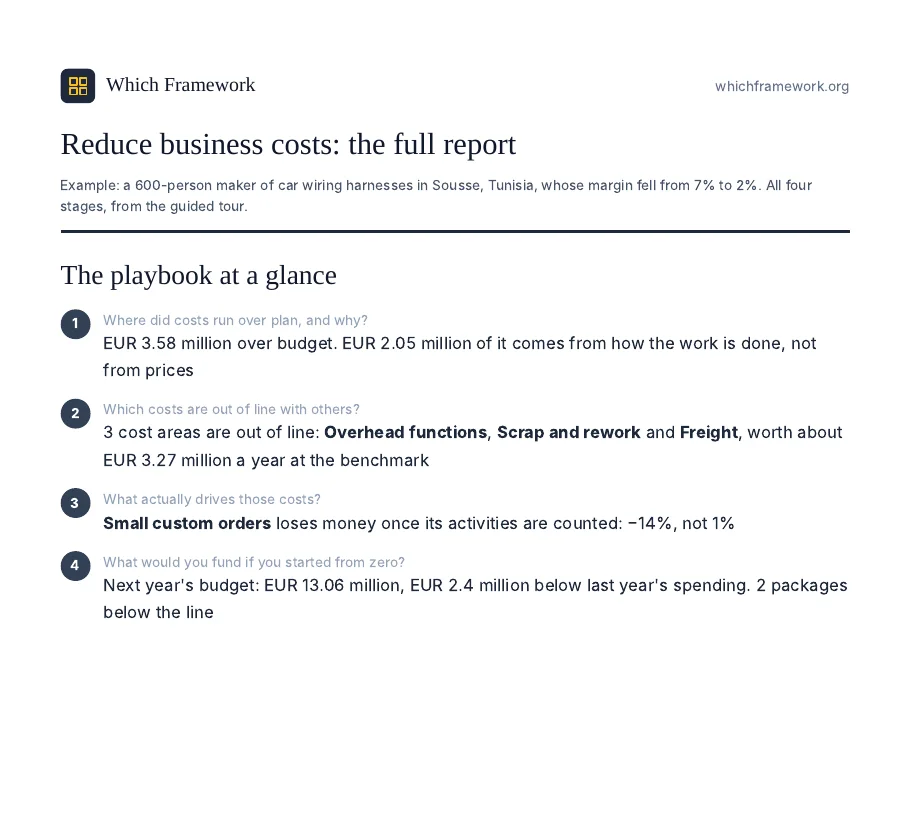
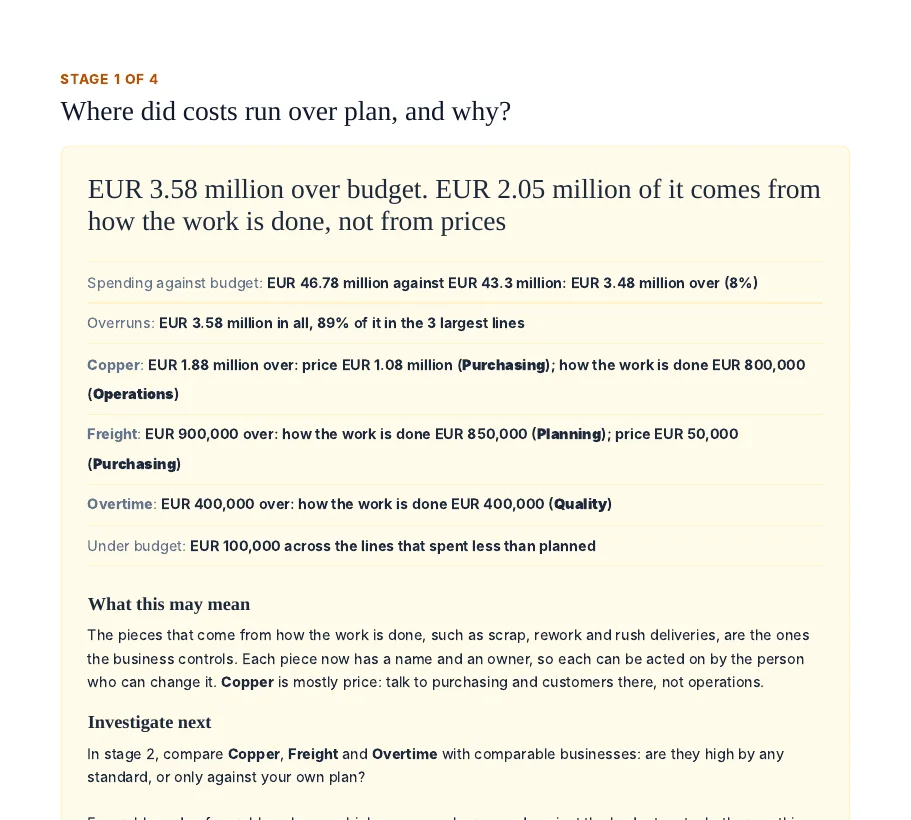
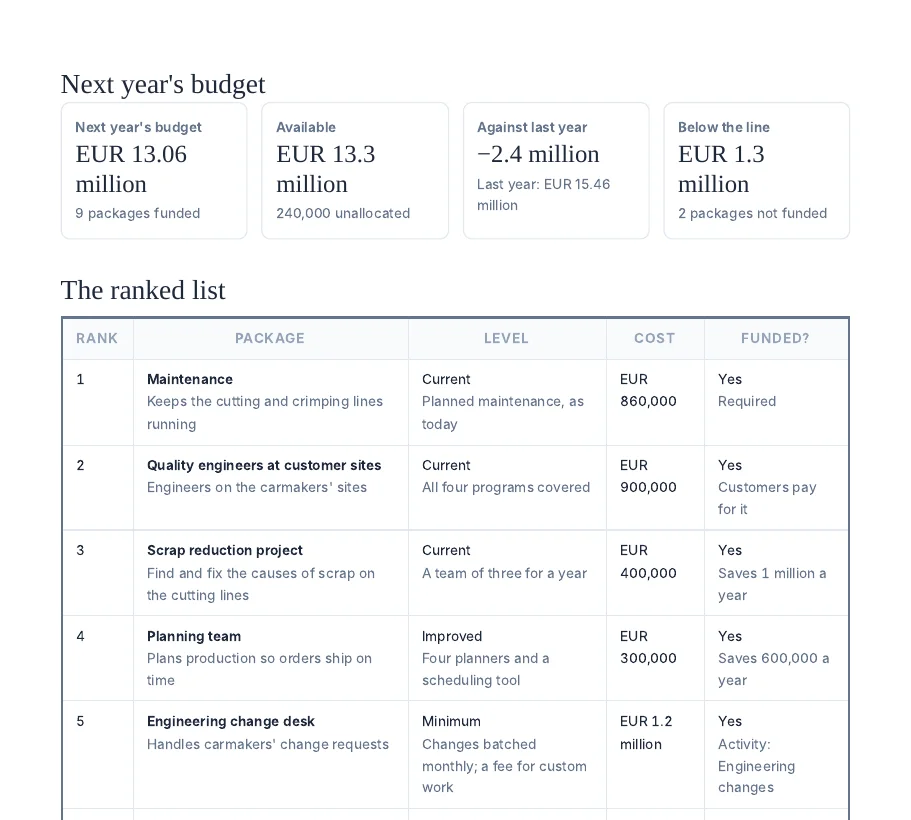
From the guided tour: a maker of car wiring harnesses in Sousse, Tunisia, whose margin fell from 7% to 2%.
Download the example report (PDF, 7 pages)A PDF report of the whole playbook. One headline for each stage, as in the example, then each stage's diagnosis: what it found, what that means, and what to do next. It ends with next year's budget, what didn't make it, and the measures to check every month.
A progress file you keep. An Excel workbook with a sheet for every stage, updated each time you save. Choose it on this page or on any stage, and the playbook reopens where you left off. The new budget also downloads as a CSV that stage 1 reads, for the monthly check.
Checks along the way. An overrun that is mostly price is sent to purchasing and customers, not operations; a benchmark with no named source is not trusted; a gap customers pay for is kept out of the cuts; work that loses money is repriced before anything is cut; and a budget that cuts what customers pay for, or what the business can't run without, is stopped.
Questions
Is it free?
Yes. There is no sign-up. The PDF report asks for an email address; everything else works without one.
Where do my figures go?
Cost lines, causes, owners and package names stay in your browser and in the progress file you download. To write each stage's diagnosis, the page sends our server only amounts and the places of items in your lists, never the names or the words.
Do I have to do all four stages?
No. Each stage also works on its own, from the tools page. If you have no budget or standard costs to compare against, start at stage 2.
Can several people work on it?
Yes, by passing the progress file. Save it after a stage, send it to a colleague, and they choose it on this page to carry on from there.
How is this different from the playbook article?
The article explains the method and follows one company through it. The tool runs the same four stages on your own figures, and writes the diagnosis at each one.