Zero-Based Budgeting (ZBB): Decision Packages, Ranking, and Why Year Two Is the Test
Zero-Based Budgeting is a budgeting method in which every activity is justified from nothing each cycle, split into decision packages that are ranked and funded down the list until the money runs out.
Before you start
Is this your framework?
ZBB answers one question: if we were starting this budget today, what would we actually fund. Last year's number stops being the starting point. Every activity has to argue for its money from nothing.
It is expensive in management time and it is unpopular, because it asks people to justify their own jobs on a schedule. The payoff is real and so is the cost, and organizations that want the first without paying the second end up with an ordinary budget and a lot of paperwork.
| If your real problem is… | You probably want |
|---|---|
| We overspent and want to know which part moved | Variance Analysis — explaining a gap against a plan you already have Compare ZBB and Variance Analysis |
| Will there be money in the account next month | Cash Flow Forecasting — liquidity and dates. ZBB decides what to spend, not when it leaves Compare ZBB and Cash Flow Forecasting |
| We do not know what our products actually cost | Activity-Based Costing — tracing costs to activities, which is a measurement problem rather than a funding decision |
| Should we make this multi-year capital commitment | Capital Budgeting — discounted appraisal. ZBB is about operating spend |
| The strategy is unclear, so nobody can rank anything | Hoshin Kanri or OKR — ranking decision packages needs an agreed set of priorities first |
| We need cuts by Friday | A percentage cut, honestly labeled as one. ZBB takes months and will not deliver a number this week |
| Costs have crept for years and nobody can say why they are there | Zero-Based Budgeting — you are in the right place |
What Is It?
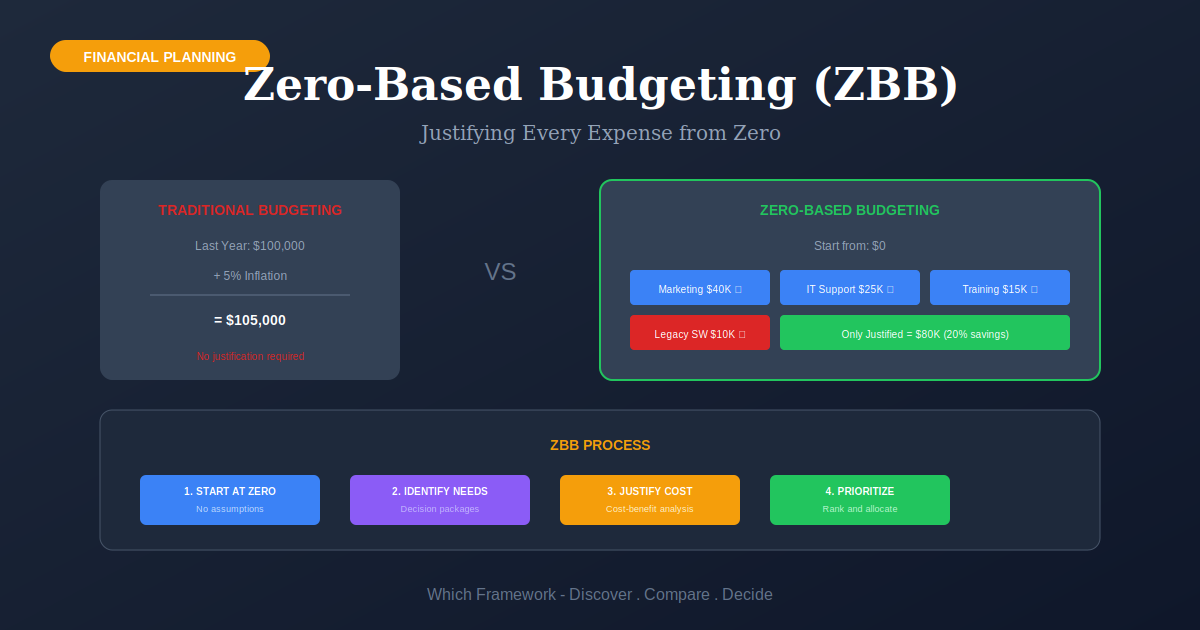
Ordinary budgeting starts with last year and argues about the change. Add four percent, take two percent off. The base is never examined, so a cost added in 2019 for a reason nobody remembers keeps getting funded because it was funded last year.
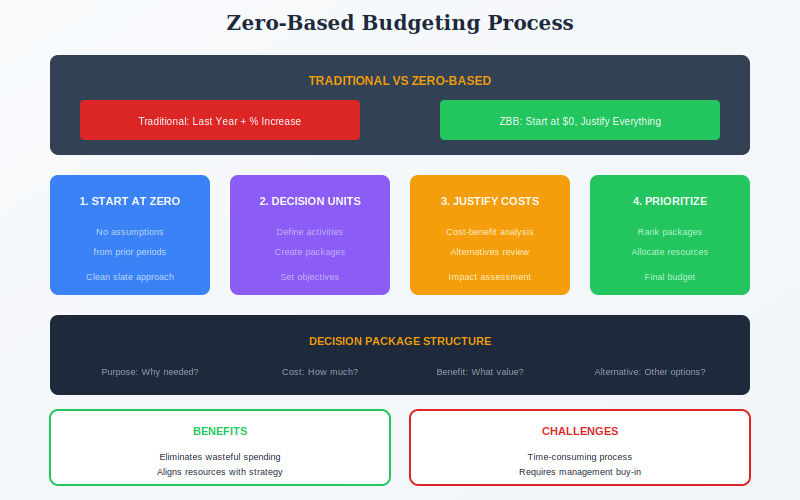
ZBB removes the base. Every activity starts at zero and has to be justified in a decision package: what it is, what it costs, what happens if it is not funded, and what a cheaper version would look like. Packages are then ranked against each other and funded down the list until the money runs out.
The ranking is the part that does the work and the part that gets avoided. Forcing managers to put their own activities in order against each other is what surfaces the ones nobody will defend, and it is why ZBB is genuinely uncomfortable rather than merely laborious.
Quick Reference
The mechanism
Decision packages, and the ranked list
A decision package is a self-contained case for one activity. The format varies; what does not vary is that it must be rankable against packages from completely different departments.
| Part | Contains | Why it matters |
|---|---|---|
| The activity | What is done, for whom, and what it produces | Written by whoever runs it. Often the first time it has been described |
| Cost | Full cost including people, at the level of effort proposed | Has to be comparable across departments or ranking is meaningless |
| Levels of effort | A minimum viable version, the current version, and an enhanced one | The most useful part and the one most often dropped. It turns a yes-or-no into how much, which is nearly always the real question |
| Consequence of not funding | What breaks, and for whom, if this gets nothing | Where the weak packages become visible. Some have no answer |
| Rank | Its position in a single ordered list across the unit | Not a category or a score. An order, which forces a choice |
Why a ranked list and not a score
Scoring lets everything be important. A list cannot: something has to be forty-first. The discomfort is the mechanism, and replacing the ranking with a rating scale is the most common way to run ZBB and get nothing from it.
The funding line then does the rest. It is drawn where the money stops, and it moves. That is also the argument for levels of effort: cutting an activity to its minimum version usually beats cutting it entirely, and a yes-or-no package hides that option.
In practice today
Where ZBB is actually applied, and the variants
Almost nobody runs true zero-based budgeting across a whole organization any more. What survived is narrower and more targeted, and it goes by several names.
| Scope | What it covers | Suits |
|---|---|---|
| Overheads and SG&A | Support functions, marketing, travel, facilities, professional fees | The dominant modern use. Discretionary spend where the base has crept and nobody owns the total |
| Zero-based sourcing procurement | Category spend rebuilt from need rather than from last year's contract volume | Indirect procurement, where specification creep and auto-renewals accumulate quietly |
| Zero-based costing | Product or service cost rebuilt from what it should cost to deliver | Manufacturing and operations. Closer to should-cost analysis than to budgeting |
| The whole budget | Every activity, every cycle, as originally proposed | Almost nobody. The cost of doing it annually across an enterprise defeated it in government and in most firms |
The compromise that made it survive
Run it on a rotating subset rather than everything at once. One function each year on a three-year cycle keeps the discipline without repeating the full exercise annually, which is the cost that killed the original version.
Watch what happens to the savings. ZBB reliably finds money. Whether that money funds growth or simply disappears into the next year's base is a governance question the method has nothing to say about, and unclaimed savings quietly return.
Core Features
- No base: last year's spend is not the starting point for anything
- Decision packages: one per activity, with cost, consequence and alternatives
- Levels of effort: minimum, current and enhanced versions of the same activity
- A single ranked list: an order across departments, not a score
- A funding line: drawn where the money stops, and movable
- Expensive: months of management time, which is the constraint on how often it runs
Worked example
A consumer goods firm in Izmir, and the line item nobody owned
An illustrative composite. A Turkish household products company, around 900 staff, applied ZBB to marketing and support functions after four years of budgets built by adding a percentage.
| Stage | What happened |
|---|---|
| The packages | 141 decision packages across marketing, IT, HR and facilities. Writing them took eleven weeks, considerably longer than the six planned. |
| What ranking exposed | A market research retainer of about TRY 4.6 million a year. Nobody could name a decision it had informed in two years, and it ranked 118th of 141 once its own department had to place it. |
| Where levels of effort paid | Eight activities were cut to their minimum version rather than stopped. Roughly TRY 9 million saved without losing the capability, which a yes-or-no format would have missed. |
| What it cost | Around 2,400 hours of manager time. Two departments produced packages that were unusable on the first pass because nobody had explained what a consequence statement was. |
| What happened next year | The exercise was not repeated. By the following cycle about a third of the savings had reappeared under different headings, because no one owned the reduced base. |
Year two is the test, not year one
The first run of ZBB almost always finds money. Keeping it is the hard part, and this is the failure that sank the technique in government: a large one-off gain, an exhausted organization, and a base that quietly rebuilt itself.
Note also the training cost. Two departments wrote unusable packages, which is exactly what Pyhrr reported from Georgia's first year in 1973. It is the most predictable problem in the method and it is still not budgeted for.
When to Use
- Costs have grown for years by increments and nobody can explain the base
- Overheads and discretionary spend specifically, which is where it still works
- After a merger, where two cost bases have been added together and never reconciled
- When savings must fund something specific, so the money has somewhere to go
- Procurement categories where specifications and renewals have crept
- On a rotating subset of functions, rather than everything every year
When NOT to Use
- When cuts are needed within weeks, since a proper cycle takes months
- Across an entire organization annually, which is what defeated the original version
- Where priorities are not agreed, because packages cannot be ranked against nothing
- For direct production costs governed by volume rather than by discretion
- Without training, since untrained managers write packages that cannot be ranked
- As a disguised headcount cut, which people identify quickly and respond to accordingly
In practice
How ZBB fails
The method is sound and demanding. Nearly every failure is an attempt to get the result without paying the cost.
| Failure mode | What it looks like | What to do instead |
|---|---|---|
| Scoring instead of ranking | Every package rated high priority, and nothing is ordered | Force a single list. Something has to be last, and that is the entire mechanism. |
| Done once | A large first-year saving, no repeat, and the base back within two cycles | Put the reduced base under a named owner, and run a rotating cycle rather than a one-off. |
| No levels of effort | Packages framed as fund or cut, so useful activities are stopped outright | Require a minimum version of every activity. Most savings come from reduction, not elimination. |
| No training | First-pass packages that cannot be compared with each other | Train the format before the cycle starts. This failure was documented in the first government implementation. |
| Savings unassigned | Money found, nowhere for it to go, and it reappears next year | Decide in advance what the savings fund. Unclaimed savings return. |
| Everything at once | An enterprise-wide cycle that exhausts the organization and is never repeated | Rotate. One function a year on a three-year cycle keeps the discipline affordable. |
Sourced
Evidence, and how to cite it
Pyhrr built it at Texas Instruments, aged 27.
He was a manager at Texas Instruments in Dallas in the late 1960s, dealing with cost creep during rapid growth in semiconductors. He sent an article to Harvard Business Review, was surprised when they ran it, and set the method out fully in a book three years later. Texas Instruments adopted it company-wide from 1970.
Pyhrr, P.A. (1970) ‘Zero-Base Budgeting’, Harvard Business Review, November–December, pp. 111–121; Pyhrr, P.A. (1973) Zero-Base Budgeting: A Practical Management Tool for Evaluating Expenses. New York: Wiley.
It went to government through Jimmy Carter, twice.
As Governor of Georgia, Carter hired Pyhrr in 1970 to adapt the method for the state, and it ran for the 1973 fiscal year budget. As President, he mandated it across federal agencies for the 1979 budget through guidelines issued in April 1977. It is the reason most people have heard of ZBB at all.
US Office of Management and Budget guidance, April 1977; see also Schick, A. and Hatry, H. (1982) ‘Zero Base Budgeting: The Manager's Budget’, Public Budgeting and Finance, 2(1), pp. 72–87.
The government version collapsed under its own weight.
Reagan dropped the federal mandate in 1981 and the technique went into a long decline. The problem was never the logic. Justifying every activity from zero across an entire government annually consumed more analytical capacity than existed, and the ranking that gives the method its force is precisely what does not scale.
Documented across the public administration literature of the period, including Schick and Hatry (1982).
Its inventor reported the training problem immediately.
In Georgia's first year Pyhrr found many decision-unit submissions were useless, because participants had not been trained in the process or in budget analysis and did not know what a decision package required. Fifty years later this is still the most common first-cycle failure, and it is still rarely budgeted for.
Pyhrr (1973), on the Georgia implementation.
How to cite it.
Harvard: Pyhrr, P.A. (1970) ‘Zero-Base Budgeting’, Harvard Business Review, 48(6), pp. 111–121.
APA: Pyhrr, P. A. (1970). Zero-base budgeting. Harvard Business Review, 48(6), 111–121.
For the method in full, cite the 1973 book. Treat consultancy savings figures with care: most published numbers come from firms selling ZBB implementations.
Key Strengths
- Examines the base: which no other budgeting method does at all
- Finds unowned spend: the retainer nobody can connect to a decision
- Levels of effort beat yes-or-no: most savings come from reducing, not stopping
- Forces explicit priorities: a single list cannot be fudged the way a score can
- Works well on overheads: where discretion is high and ownership is weak
Key Weaknesses
- Costly in management time: months of it, which is why it is rarely repeated
- Does not scale annually: the failure that ended the government version
- The base rebuilds: savings return unless somebody owns the reduced number
- Needs agreed priorities: ranking is impossible without them
- Unpopular by design: it asks people to rank their own work against colleagues'
- Evidence is mostly vendor-supplied: the savings claims come from firms selling it
Sequencing
What to run before and after
Ranking packages requires priorities that come from elsewhere, and the savings need somewhere to go or they return.
Before
Agree what the organization is trying to do
Packages from different departments have to be ranked against each other, and that is impossible without a shared set of priorities. Without one, ranking becomes a contest between departments.
During
Get costs that are comparable across departments
A package is only rankable if its cost means the same thing as the one it is ranked against. Inconsistent cost allocation quietly decides the ranking.
After
Hold the new base
The savings are found in year one and lost by year three unless somebody owns the reduced number and the drift is measured against it.
Common questions
ZBB: quick answers
What is zero-based budgeting?
A budgeting method in which every activity is justified from nothing each cycle rather than adjusted from last year's number. Activities are written up as decision packages setting out cost, consequence of not funding, and cheaper alternatives; the packages are then ranked in a single list and funded down it until the money runs out.
What does ZBB stand for?
Zero-based budgeting, sometimes written zero-base budgeting, which is the original spelling used by Peter Pyhrr. The two are the same thing. The abbreviation is standard in finance and consulting, and related terms include zero-based costing and zero-based sourcing, which apply the same logic to product cost and to procurement.
What is a decision package?
A self-contained case for one activity: what it is and what it produces, its full cost, what happens if it receives nothing, and what a minimum, current and enhanced version would each cost. The levels of effort are the most valuable part and the most often dropped, because they turn a fund-or-cut question into a how-much question.
How is ZBB different from traditional budgeting?
Traditional or incremental budgeting takes last year's figure as given and argues about the change, usually applying a percentage. ZBB treats the base as zero, so an activity funded for years has to make its case again from scratch. The practical difference is that incremental budgeting can never examine why a cost exists at all.
Is zero-based budgeting used in procurement?
Yes, and it is one of the places it still works well. Zero-based sourcing rebuilds category spend from what is actually needed rather than from last year's contract volume, which suits indirect categories where specifications drift upward and contracts auto-renew. It is narrower than full ZBB and correspondingly more likely to be finished.
What is the difference between zero-based budgeting and zero-based costing?
Budgeting decides what to fund; costing decides what something should cost. Zero-based costing rebuilds the cost of a product or service from the resources genuinely required to deliver it, which makes it closer to should-cost analysis than to budgeting. They share the principle of refusing to start from the existing number.
Does zero-based budgeting actually work?
It reliably finds money in the first cycle. Holding the reduction is where it fails: without an owner for the new base, savings reappear under different headings within a couple of years. Be careful with published savings figures, since most come from firms that sell ZBB implementations. The failure of the 1977 federal program was about scale and cost, not about the logic.
How long does a ZBB cycle take?
Three to four months for a first cycle covering a meaningful part of the organization, and longer than planned almost every time. Writing the packages is the slow part, and untrained managers produce packages that cannot be ranked, which means doing it twice. Later cycles are faster, which is an argument for rotating through functions rather than running it once.
Deep Resources
Frameworks related to Zero-Based Budgeting
- Variance AnalysisFor holding the reduced base once ZBB has found it…
- Activity-Based CostingComparable costs across departments, without which ranking is arbitrary…
- Cash Flow ForecastingWhat the spending decision means for the bank balance, week by week…