FreeNo sign-upYour data stays on your computer
Churn Reduction Tool
Find which customers leave and when, who is likely to go next, why they leave, where the experience breaks, and which fixes to make first. Five stages, each picking up where the last left off, ending with a plan of fixes and a full report.
The tour runs all five stages on an example chain of four gyms. Nothing in it touches your own work. Allow six to nine weeks in all: most of it goes on survey answers and conversations, not on the tools.
Five stages, in order
Each stage asks one question and hands its answer to the next. You can stop after any stage: save your progress file, and pick up later on any computer. The customer churn playbook explains the method behind each one.
-
Stage 1 of 5 · Churn analysis
Who leaves, and when?
1 to 2 weeks
- You bring
- An export of your customer list: when each customer started, when they canceled, and their plan, branch or region.
- You get
- Where churn is concentrated: by how long customers stayed, and by plan or group.
-
Stage 2 of 5 · Net Promoter Score
Who is likely to leave next?
2 to 3 weeks
- You bring
- Answers to a one-question survey sent to current customers. The tool plans whom to ask and how many answers you need.
- You get
- Current customers sorted by loyalty, with the unhappy ones named, group by group.
-
Stage 3 of 5 · Voice of the Customer
Why do customers leave?
2 to 3 weeks
- You bring
- 20 to 30 short conversations with customers who left and with unhappy ones, using the tool's interview guide.
- You get
- The needs that went unmet, ranked by how often they come up.
How Voice of the Customer worksUse the Voice of the Customer tool on its own
-
Stage 4 of 5 · Customer journey map
Where does the experience break?
1 week
- You bring
- One to two hours with the people who meet customers, to map the journey stage by stage.
- You get
- The moments where the experience breaks, and ideas to fix each one.
How journey mapping worksUse the journey map tool on its own
-
Stage 5 of 5 · Value vs Effort Matrix
Which fixes come first?
Half a day
- You bring
- A team meeting: value from the customer evidence, effort from the people who will do the work.
- You get
- Quick wins to start now, the larger projects worth funding, and what to leave.
How the Value vs Effort Matrix worksUse the value vs effort tool on its own
What you finish with
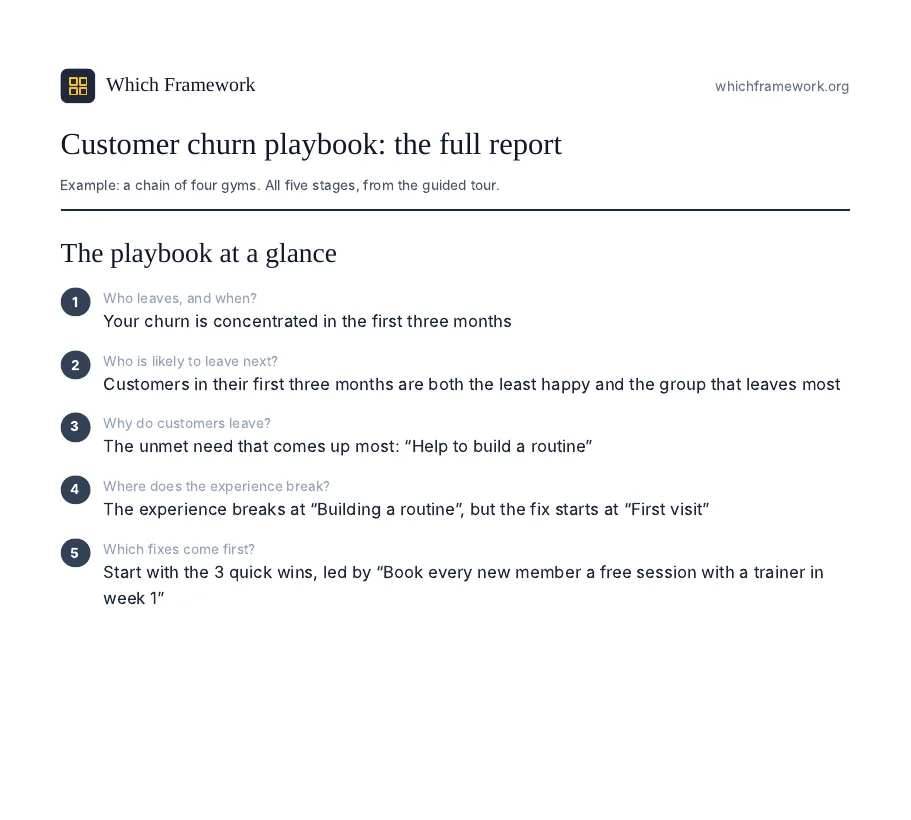
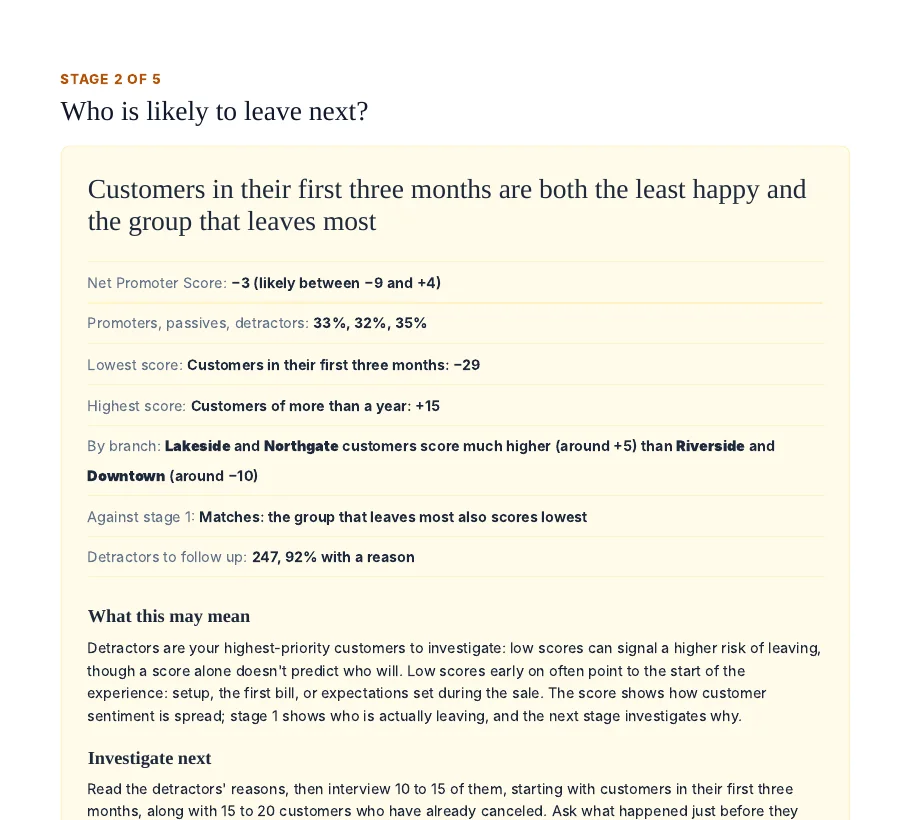
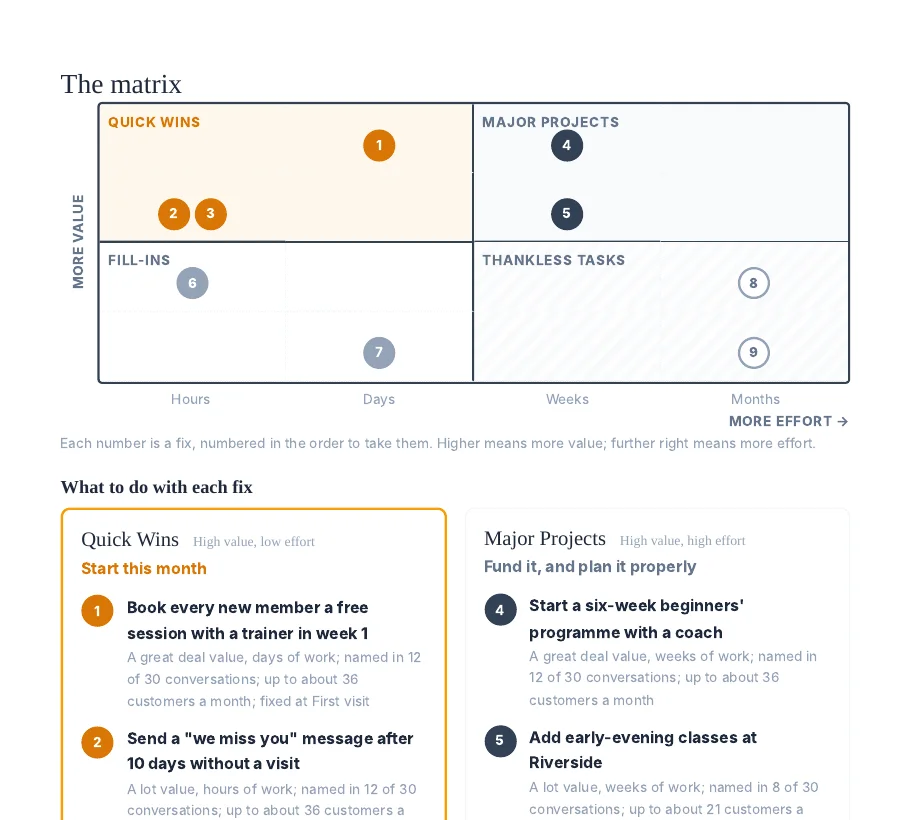
From the guided tour: a chain of four gyms with about 2,000 members.
Download the example report (PDF, 8 pages)A PDF report of the whole playbook. One headline for each stage, as in the example, then each stage's diagnosis: what it found, what that means, and what to do next. It ends with the fixes, sorted into quick wins, major projects, fill-ins and thankless tasks.
A progress file you keep. An Excel workbook with a sheet for every stage, updated each time you save. It is also how you come back: choose it on this page or on any stage, and the playbook reopens where you left off.
Work you can hand on. Some stages are best done by others: front-line staff map the journey, and the people who will do the work score the effort. Send them the progress file.
Questions
Is it free?
Yes. There is no sign-up. The PDF report asks for an email address; everything else works without one.
Where does my customer data go?
Your customer list, survey answers and notes stay in your browser and in the progress file you download. To write each stage's diagnosis, the page sends our server only counts, rates and ratings, never names or notes.
Do I have to do all five stages?
No. Each stage also works on its own, from the tools page. In order, though, each stage narrows the next one down: the survey and the conversations go to the customers most likely to leave.
Can several people work on it?
Yes, by passing the progress file. Save it after a stage, send it to a colleague, and they choose it on this page to carry on from there.
How is this different from the playbook article?
The article explains the method and follows one company through it. The tool runs the same five stages on your own customers, and writes the diagnosis at each one.