FreeNo sign-upYour notes stay on your computer
Process Improvement Tool
Find out where a slow process spends its time, and fix the one step that holds everything up: map the waiting and the work, confirm the bottleneck, change it in a short event and check the gain held, then put every step on a board with limits. Four stages, ending with the lead time to track and a full report.
The tour runs all four stages on an example bank's mortgage process. Nothing in it touches your own work. About a week on the fast track. Done thoroughly, stages 1 and 2 take two to three weeks, stage 3 is a five-day event with a check 30 days later, and stage 4 then runs every day.
Four stages, in order
Each stage asks one question and hands its answer to the next. You can stop after any stage: save your progress file, and pick up later on any computer. The process speed-up playbook explains the method behind each one.
-
Stage 1 of 4 · Value Stream Mapping
Where does the time go?
1 to 2 weeks
- You bring
- Ten to thirty recent items: the date each reached each step and when it finished, from your system or a spreadsheet, and how long the work at each step takes.
- You get
- The process on one page: lead time against working time, and the longest wait.
How value stream mapping worksUse the value stream mapping tool on its own
-
Stage 2 of 4 · Theory of Constraints
Which step holds everything up?
2 to 3 days
- You bring
- A few days watching the slowest step: whether work piles up, whether the steps after it wait, whether it is ever idle.
- You get
- The bottleneck, confirmed by three signs, and a plan for each of the Five Focusing Steps.
How the Theory of Constraints worksUse the Bottleneck Finder on its own
-
Stage 3 of 4 · Kaizen Blitz
How do you fix that step quickly?
A five-day event, then a check 30 days later
- You bring
- Six to eight people for a week: the people who do the step, its neighbours, and someone who can change a form or a rule.
- You get
- A change tested on real work, written down as the standard with an owner, and whether the gain held after 30 days.
How a Kaizen Blitz worksUse the Kaizen Blitz Planner on its own
-
Stage 4 of 4 · Kanban
How do you stop work piling up again?
Set up during the event, then daily
- You bring
- A count of what sits in each step now, the items finished in a normal week, and ten minutes a day at the board.
- You get
- A limit on every step, the lead time the board implies, and the next bottleneck from weekly counts.
How Kanban worksUse the Kanban WIP Limit Calculator on its own
What you finish with
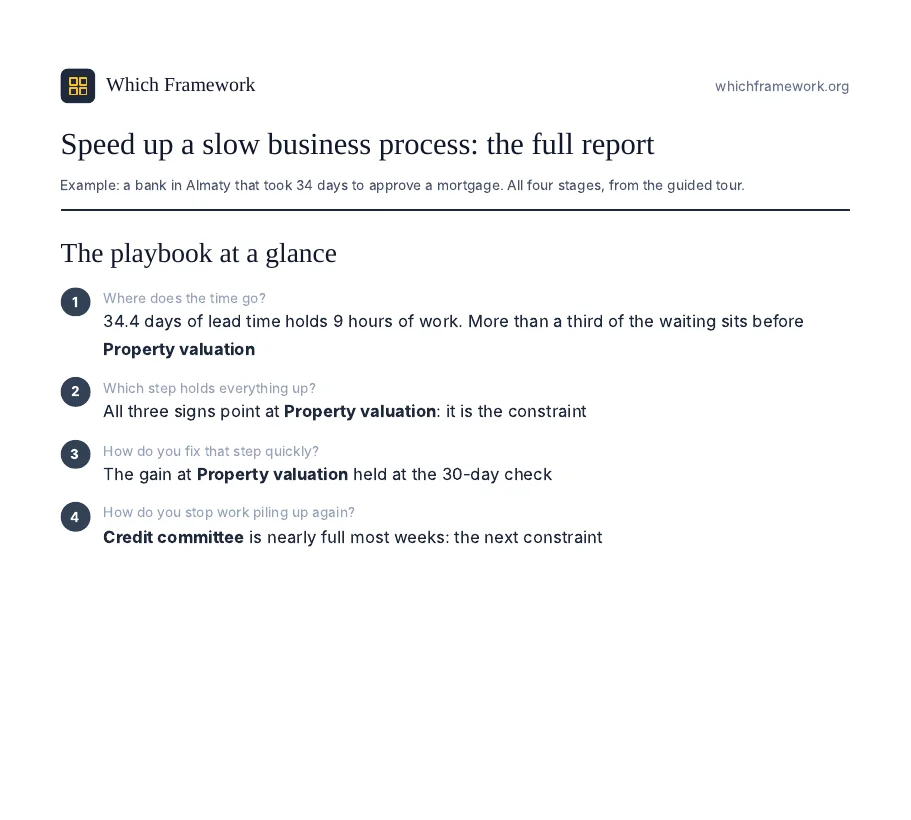
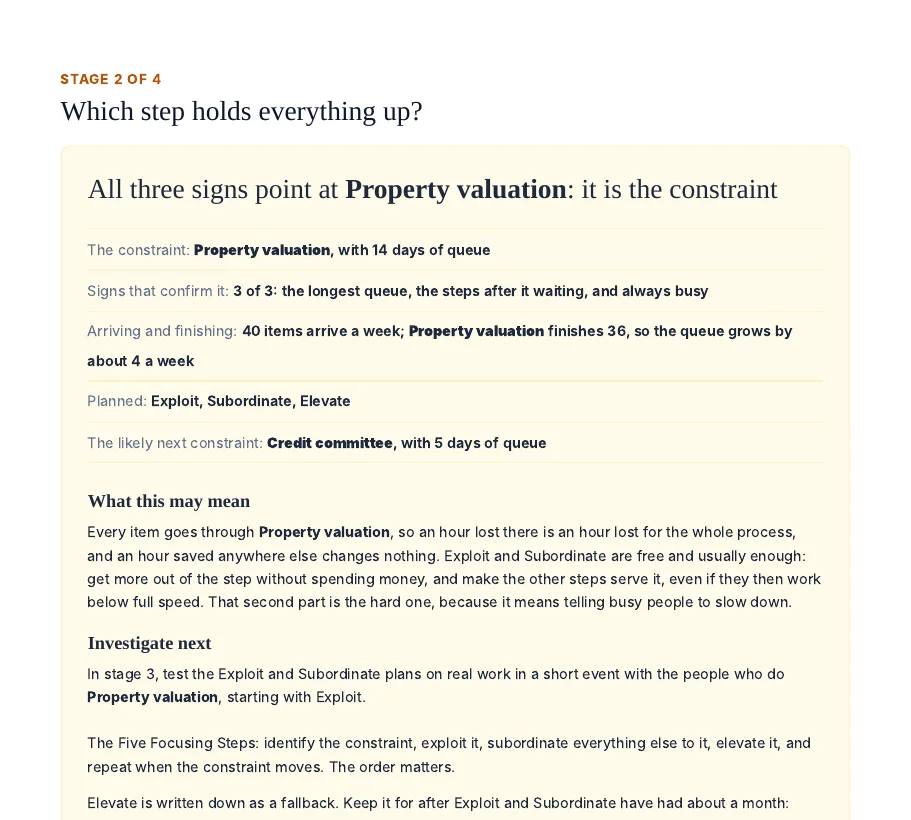
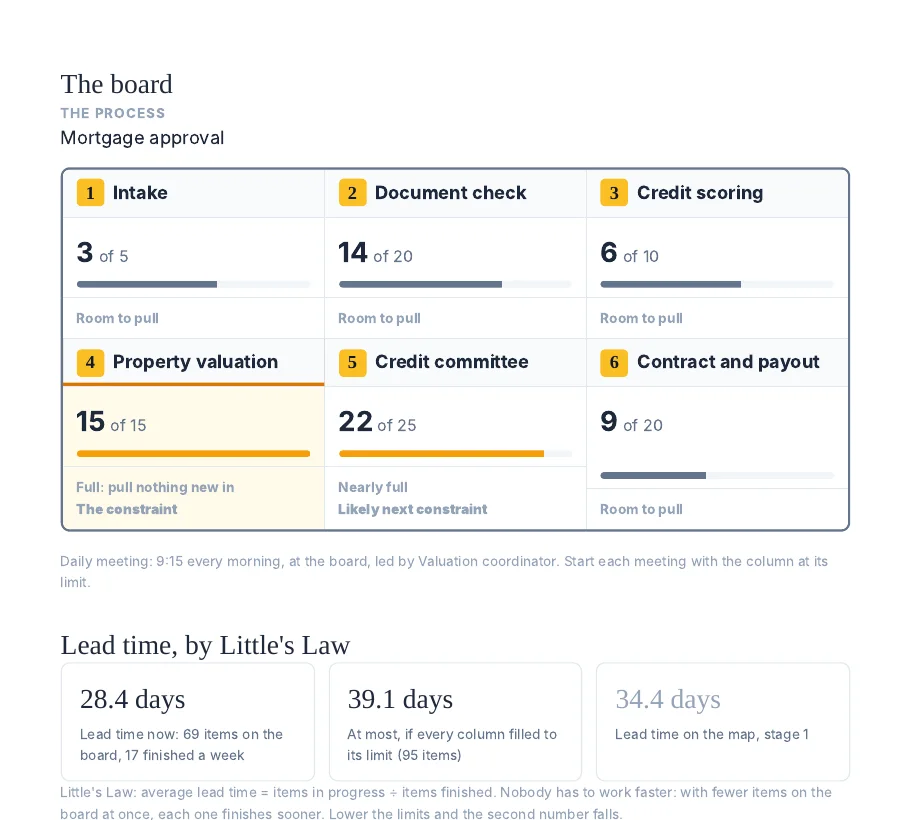
From the guided tour: a bank in Almaty that took 34 days to approve a mortgage.
Download the example report (PDF, 7 pages)A PDF report of the whole playbook. One headline for each stage, as in the example, then each stage's diagnosis: what it found, what that means, and what to do next. It ends with the board, the lead time to track every week, and the next bottleneck.
A progress file you keep. An Excel workbook with a sheet for every stage, updated each time you save. It is how you come back for the 30-day check and the weekly counts: choose it on this page or on any stage, and the playbook reopens where you left off.
Checks along the way. A process slowed by errors rather than waiting is sent to Lean Six Sigma; a step with a queue that isn't always busy isn't taken for the bottleneck; adding people before getting more from the step is stopped; a gain that faded within a month stops the playbook; and limits too loose to bite are flagged.
Questions
Is it free?
Yes. There is no sign-up. The PDF report asks for an email address; everything else works without one.
Where do my notes go?
Step names, dates, notes and the team stay in your browser and in the progress file you download. To write each stage's diagnosis, the page sends our server only times, counts and the places of items in your lists, never the names or the words.
Do I have to do all four stages?
No. Each stage also works on its own, from the tools page. If you already know which step holds everything up, start at stage 2.
Can several people work on it?
Yes, by passing the progress file. Save it after a stage, send it to a colleague, and they choose it on this page to carry on from there.
How is this different from the playbook article?
The article explains the method and follows one bank through it. The tool runs the same four stages on your own process, and writes the diagnosis at each one.