Theory of Constraints: Focus on What Limits Performance
Theory of Constraints (TOC) is a management philosophy that identifies the most critical limiting factor (constraint) standing in the way of achieving a goal, then systematically improves that constraint using the Five Focusing Steps.
Before you start
Is the Theory of Constraints your framework?
TOC rests on one claim: every system has exactly one constraint that limits its output, and everything else is, by definition, not the problem. Improve a non-constraint and total output does not move.
That makes it powerful where throughput is what matters and one step is genuinely the bottleneck. It makes it a poor fit where the problem is quality, direction, or a system with no clear flow.
| If your real problem is… | You probably want |
|---|---|
| Work is invisible and we cannot see where it stalls | Kanban — makes bottlenecks visible; TOC tells you what to do once one is found Compare Kanban and TOC |
| Defects and variation are the issue, not capacity | Lean Six Sigma — TOC targets throughput, not quality Compare TOC and Lean Six Sigma |
| We need to see the whole process before judging it | Value Stream Mapping — map first, then find the constraint Not sure which? Compare |
| We want steady incremental improvement everywhere | Kaizen — the philosophical opposite: improve everywhere, versus improve only at the constraint Not sure which? Compare |
| Projects finish late and we need better scheduling | Critical Path Method, or Goldratt’s own Critical Chain, which applies TOC to projects Not sure which? Compare |
| One step is clearly limiting how much we can deliver | TOC — you are in the right place |
The distinction that matters
Goldratt’s formulation is the sharpest test: an hour lost at the constraint is an hour lost for the entire system; an hour saved at a non-constraint is a mirage. If your improvement program is raising utilization everywhere, TOC predicts it will produce more inventory and no more output — and that prediction is usually correct.
What Is It?
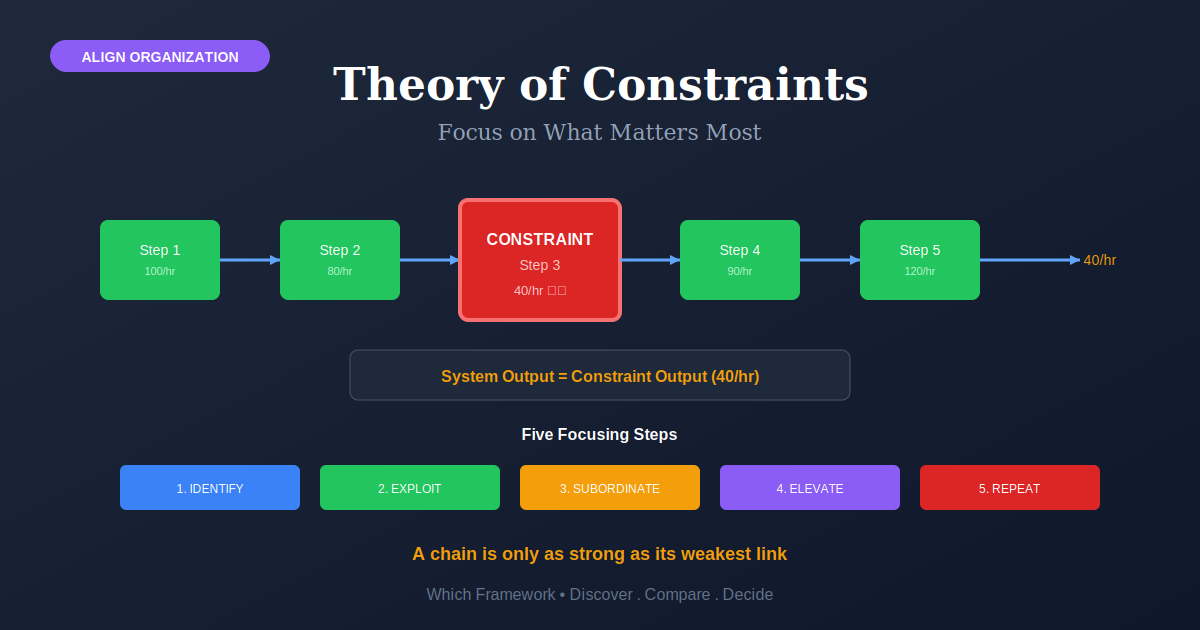
Theory of Constraints, developed by Dr. Eliyahu M. Goldratt and introduced in his 1984 business novel "The Goal," is based on a simple but powerful premise: every system has at least one constraint that limits its performance. A chain is only as strong as its weakest link.
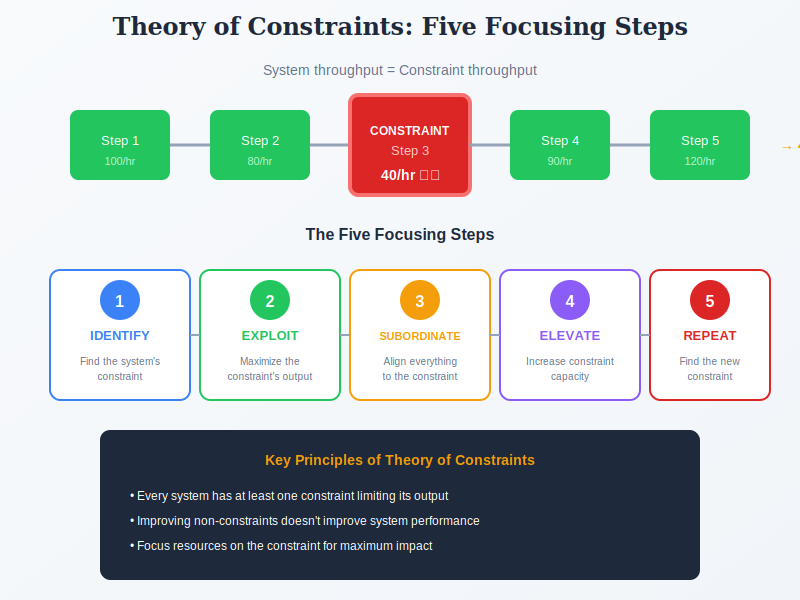
The insight is that improving anything other than the constraint is largely wasted effort. If a factory can produce 100 units per hour at Step A but only 40 units per hour at Step C (the constraint), the system output is 40 units per hour no matter how much you improve Steps A, B, or D.
TOC provides the Five Focusing Steps: Identify the constraint, Exploit it (get maximum output from it), Subordinate everything else to the constraint's needs, Elevate the constraint (add capacity), and Repeat when the constraint moves. This creates a continuous improvement cycle focused on what matters most.
TOC has been applied successfully in manufacturing, software development, project management, supply chain, and even personal productivity. It aligns naturally with Value Stream Mapping and Lean Strategy.
Quick Reference
The core method
The five focusing steps
Goldratt’s process of ongoing improvement. The sequence matters — each step is only valid once the previous one is genuinely done, and the most common failure is skipping straight to step 4.
| # | Step | What it actually requires | How it goes wrong |
|---|---|---|---|
| 1 | Identify the constraint | Find the one step that limits system output. It is usually where work piles up in front and starvation follows behind. | Naming a step everyone already dislikes rather than the one the queue points at. |
| 2 | Exploit the constraint | Get more out of it without spending money: stop it idling, remove non-essential work from it, inspect before it rather than after. | Skipped entirely in favor of buying capacity. This step is free and usually sufficient. |
| 3 | Subordinate everything else | Every non-constraint runs at the constraint’s pace — deliberately underused. This is the hardest step politically, because it means telling productive people to slow down. | Refused. Local efficiency targets survive, the constraint keeps starving, and TOC gets blamed. |
| 4 | Elevate the constraint | Now spend money: add capacity, hire, buy the machine, outsource the step. | Done first. Expensive, and often unnecessary once step 2 is complete. |
| 5 | Repeat — and beware inertia | When the constraint moves, go back to step 1. Goldratt’s explicit warning: do not allow inertia to become the constraint. | The clause most summaries drop. Rules written for the old constraint quietly become the new one. |
Why step 3 decides everything
Steps 1, 2 and 4 are technical and mostly uncontroversial. Step 3 is where TOC either works or dies, because subordination requires accepting visible idleness at non-constraints — and almost every management system in existence rewards local utilization. If your organization measures every department on how busy it is, you will not get past step 3, and the framework cannot fix that for you.
Core Features
- Five Focusing Steps: Structured process for continuous constraint management
- Throughput Accounting: Financial measures focused on system output
- Drum-Buffer-Rope: Production scheduling based on constraint capacity
- Critical Chain: Project management method protecting the constraint
- Thinking Processes: Logic-based tools for identifying root causes
- System Thinking: Views organization as interconnected system
Worked example
Five steps, with the arithmetic
An illustrative composite. A mid-sized custom cabinet manufacturer in North Carolina, shipping around 40 units a week against demand for 60. Every department reported high utilization, and the assumption was that more capacity was needed everywhere.
| Step | What they found or did | Effect on throughput |
|---|---|---|
| 1. Identify | Finishing was the constraint — 40 units/week capacity against 55 upstream. Work in progress sat six days deep in front of it; assembly downstream idled two days a week. | — |
| 2. Exploit | Finishing had been shutting for lunch and shift changeover, losing ~7 hours a week. Quality inspection moved to before finishing, so no rework was ever finished twice. No money spent. | 40 → 49 units/week |
| 3. Subordinate | Upstream cutting and assembly slowed to finishing’s pace. Departmental efficiency targets removed. Two supervisors objected; one escalated. | 49 → 52, and WIP fell from six days to two |
| 4. Elevate | Only now: a second spray booth, $60k. Justified against the 8 units/week still unmet. | 52 → 60 units/week |
| 5. Repeat | Constraint moved to the drying racks. Back to step 1. The old efficiency targets were formally retired so they could not creep back. | Ongoing |
What the sequence bought them
Step 2 delivered 9 of the 20 extra units, and cost nothing. The instinct in the room had been to start at step 4 and buy a booth — which would have worked, at $60k, while leaving the free capacity untouched. Running the steps in order made the eventual purchase both smaller and easier to justify.
Note step 3’s cost: it made two departments visibly less busy, and someone escalated. That is not a sign it went badly. It is what subordination looks like in an organization that measures local efficiency.
When to Use
- System performance is clearly limited by a bottleneck
- Improvement efforts seem scattered and unfocused
- Resources are limited and you need to prioritize
- Manufacturing or operations optimization
- Project management with resource constraints
- Complementing Value Stream Mapping to find focus
When NOT to Use
- Market demand is the constraint (need sales/marketing focus)
- System is simple with no clear bottleneck
- Early-stage startups still finding product-market fit
- When broad cultural change is needed first
- Creative work where constraints are less clear
In practice
How TOC implementations fail
The logic is simple enough to explain in ten minutes. Almost every failure is organizational rather than analytical.
| What you see | What it usually means | What to do |
|---|---|---|
| Several constraints are identified at once | Steps were confused with the constraint | There is one binding constraint at a time. Follow the queue: work piles up in front of it and starves behind it. If nothing is piling up, you may be demand-constrained, not capacity-constrained. |
| The team went straight to buying capacity | Step 2 was skipped because step 4 is easier to authorize | Exhaust exploitation first. Idle time, setup, rework and non-essential work at the constraint are usually worth double digits, and cost nothing. |
| Non-constraints still have efficiency targets | Subordination was agreed in principle and not in the measurement system | Remove or change the local metrics. Subordination and local utilization targets cannot both survive; whichever is measured will win. |
| Output did not move despite improvements | The improvements were at non-constraints | Expected. An hour saved at a non-constraint changes nothing. Check every improvement against the constraint before funding it. |
| The constraint moved and nobody noticed | Step 5 was treated as an ending rather than a loop | Re-run step 1 after every significant elevation. The constraint always moves; the question is whether you find it or it finds you. |
| Old rules persist after the constraint moved | Inertia has become the constraint — Goldratt’s own warning | Formally retire policies written for the previous bottleneck. Unlike a machine, a policy constraint has no queue in front of it to give it away. |
Sourced
What the evidence says
It was introduced in a novel, which is unusual and consequential.
Eliyahu Goldratt and Jeff Cox published The Goal in 1984 as a business novel following a plant manager trying to save his factory. It has sold in the millions and been translated into dozens of languages, and it is why TOC spread through operations management faster than more rigorously argued methods. Goldratt set out the framework directly in later work, including What Is This Thing Called Theory of Constraints? and Critical Chain, which applies the same logic to project scheduling.
Goldratt, E. M. & Cox, J., The Goal: A Process of Ongoing Improvement, North River Press, 1984.
The reported results are large.
Victoria Mabin and Steven Balderstone conducted the landmark academic review, a meta-analysis of published TOC applications drawing on available quantitative data. Across the implementations they examined, median reported improvements were roughly 70% reduction in lead time, 49% reduction in inventory, and 68% increase in throughput. Those are unusually large figures for any management intervention.
Mabin, V. J. & Balderstone, S. J., “The performance of the theory of constraints methodology: analysis and discussion of successful TOC applications”, International Journal of Operations & Production Management 23(6), 2003, pp. 568–595.
And the same study contains the reason to discount them.
Read the title again: it analyzes successful applications. The authors report that despite extensive searching they found no published reports of TOC failures at all. That is not a success rate — it is a missing denominator. Nobody writes up the implementation that stalled at subordination, and consultancies do not publish the engagement that went nowhere. Treat the figures as evidence of what TOC achieves when it works, not of how often it works. The honest summary is that TOC has a strong record among documented cases and an unknown failure rate, and any source quoting those numbers without that caveat is quoting them wrongly.
What that means for using it.
The core logic is close to unarguable: if one step limits output, improvements elsewhere cannot raise output. The risk is not that the theory is wrong but that step 3 is organizationally impossible where you work. Before starting, ask one question honestly — will leadership accept that some departments should be visibly idle? If the answer is no, you will get the gains from step 2 and stop there. Those gains are real and free, so it is still worth doing. Just do not budget for the rest.
Key Strengths
- Focus: Concentrates improvement efforts where they matter
- Simplicity: Core concept is easy to understand
- Results: Often produces dramatic, rapid improvements
- Resource Efficient: Maximizes output from existing resources
- Systemic: Prevents local optimization that hurts overall performance
Key Weaknesses
- Identifying the true constraint can be difficult
- Constraint may move, requiring ongoing attention
- Can create resistance from non-constraint areas
- Less applicable when constraints are external (market, policy)
- Requires discipline to maintain focus on constraint
How It Works
| 1 Primary Input | Process flow data, throughput measurements, constraint identification |
|---|---|
| 2 Data You Need | Capacity at each step, work-in-progress levels, demand rates |
| 3 Primary Output | Focused improvement plan, scheduling approach, increased throughput |
Comparison with Related Frameworks
Theory of Constraints vs Value Stream Mapping
Value Stream Mapping visualizes the entire flow; TOC focuses on the constraint. Use VSM to see the whole picture, then TOC to prioritize improvement at the bottleneck.
Theory of Constraints vs Lean Strategy
Lean Strategy emphasizes waste elimination everywhere. TOC focuses resources on the constraint first. They're complementary—TOC finds focus, Lean optimizes.
Sequencing
What to run before and after
TOC tells you where to act. It does not show you the system, and it does not fix what it finds.
Before
See the flow
You cannot identify a constraint in a process nobody has mapped. Queues and idle time are the evidence, and both need to be visible before step 1 means anything.
During
Run the five steps in order
Especially steps 2 and 3, in that order and before step 4. Most of the free gains are in exploitation, and most of the difficulty is in subordination.
After
Improve the step you just found
TOC says where to work; other methods say how. Quality problems at the constraint are worth fixing precisely because they are at the constraint.
Common questions
Theory of Constraints: quick answers
What are the five focusing steps of the Theory of Constraints?
Identify the system's constraint; decide how to exploit it; subordinate everything else to that decision; elevate the constraint; and if the constraint is broken, return to step one — without allowing inertia to become the constraint. Goldratt called this the process of ongoing improvement. The order matters: steps 2 and 3 are free and must come before step 4, which costs money.
Who created the Theory of Constraints?
Eliyahu M. Goldratt, an Israeli physicist turned management thinker. He introduced it to a wide audience through The Goal, a business novel written with Jeff Cox and published in 1984, and set it out directly in later works including What Is This Thing Called Theory of Constraints? and Critical Chain, which applies TOC to project management.
What does “subordinate” mean in the Theory of Constraints?
It means running every non-constraint at the pace of the constraint, deliberately leaving spare capacity idle. It is the third step and the one that decides whether TOC works, because it directly contradicts local efficiency targets. If departments are measured on how busy they are, subordination will lose — so the measurement system has to change with it.
Does the Theory of Constraints actually work?
The published record is strong and incomplete. Mabin and Balderstone's meta-analysis of documented applications found median improvements around 70% in lead time, 49% in inventory and 68% in throughput. But the study examined successful applications and reported finding no published failures at all, which indicates publication bias rather than a perfect record. TOC has a strong record among documented cases and an unknown failure rate.
What is the difference between the Theory of Constraints and Lean?
They optimize for different things. TOC targets throughput by improving one constraint and deliberately underusing everything else. Lean targets waste and variation across the whole process. TOC would say improving a non-constraint is wasted effort; Lean would say waste anywhere is worth removing. In practice they combine well — use TOC to decide where to work and Lean methods to do the work.
How do I identify the constraint?
Follow the queue. Work accumulates in front of the constraint and the steps after it run starved. If nothing is accumulating anywhere, your constraint is probably not internal — you may be limited by demand, by a policy, or by a supplier. Policy constraints are the hardest to spot precisely because they leave no visible pile of work.
Deep Resources
Frameworks related to Theory of Constraints
- Value Stream MappingVisualize the flow of materials and information through a process to identify waste and…
- Lean StrategyApply lean principles to strategy execution with rapid iteration, validated learning, and…